Creating an email for children feels like a digital rite of passage you are probably not ready for. It’s like handing your child a key to a post office box that also receives every magazine, piece of junk mail, and weird letter in the entire world. It can be a terrifying thought.
But let’s be blunt: your child will need an email. It is the core of digital identity. It’s required for school projects, to talk to grandparents, and to sign up for the apps and games you have already approved.
The good news is that you can do this safely. You do not have to just create an email account and hope for the best. You can build a “walled garden.” This guide is your complete plan. We will cover when to create the account, which service to use (and how to set it up, click-by-click), and how to teach your child the rules of the inbox.
What Is a “Safe Email” for Children?
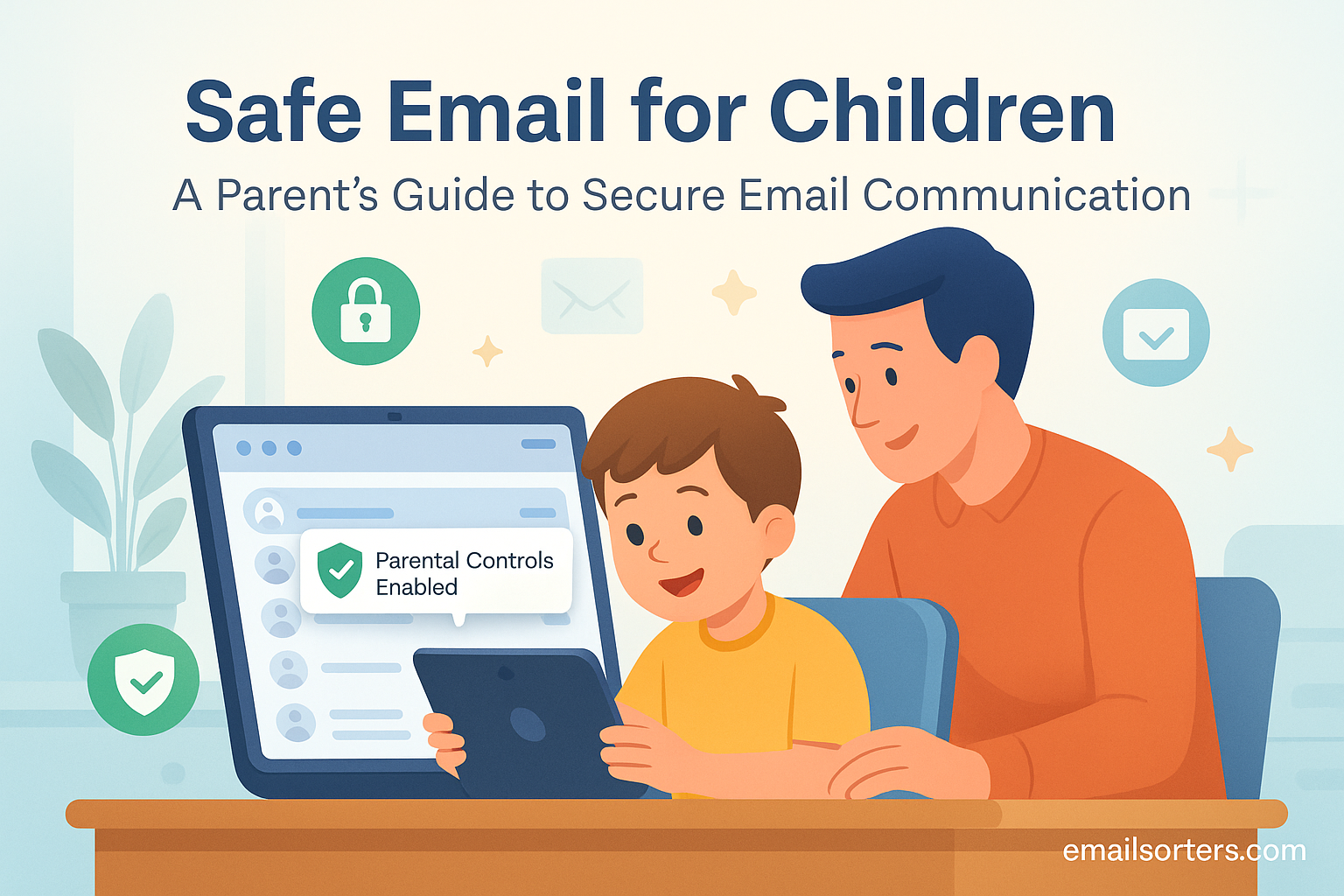
A safe email for children is a special, parent-controlled account, not a regular, open inbox. It has a “walled garden” approach. This means you control who can send emails to your child (a whitelist) and who your child can send emails to.
These accounts are designed to strip away the dangerous parts of email. They typically feature:
- No Ads: Most children’s accounts do not scan email content to serve targeted advertising.
- Contact Whitelist: The best feature. You create a list of approved senders (e.g.,
grandma@...,teacher@...). Any email from an unapproved sender is blocked. - Parental Monitoring: You get a “parent dashboard” where you can review all incoming and outgoing messages.
- Spam Filtering: Strong filters that catch junk mail and inappropriate content before it ever reaches the inbox.
A regular email account is a public mailbox. A child’s email account is a private, curated inbox.
Why Does My Child Even Need an Email Account?
Your child likely needs an email account for school, family communication, and as a “digital key.” Many educational apps, websites, and even some games require an email to create an account, and they cannot use yours.
Let’s break down the valid reasons, because “my friend has one” isn’t a good one.
- School Communication: This is the big one. As kids get older, schools start using digital tools. Teachers may ask students to email assignments or use a platform (like Google Classroom) that requires a Google account. Getting them a student email might be the end goal, but a personal, parent-managed account is the first step.
- Contacting Family: It’s a wonderful, safe way for your child to communicate with grandparents, aunts, uncles, and cousins. They can learn to write letters, share photos, and stay in touch, all within your approved contact list.
- Digital Identity (The “Key”): This is the most practical reason. Think about the apps, learning websites, or games you want your child to use. They all need a login. You cannot (and should not) use your personal email for all of them. A dedicated child’s email keeps all those sign-ups in one place.
- Learning Digital Literacy: You have to teach your child how to swim before you visit the ocean. Email is the same. A safe, controlled inbox is the “shallow end” of the internet. It’s the perfect place to teach them what spam looks like, how to write a proper message, and what “stranger danger” means online.
What Is the Right Age to Get a Child an Email?
There is no “magic age” for an email account. The right time depends on your child’s maturity, their need for one (like for school), and your ability to monitor it. Legally, the U.S. Children’s Online Privacy Protection Act (COPPA) requires parental consent for anyone under 13.
This is the most common question, and the answer is “it depends.”
- The Legal Barrier (Under 13): The reason 13 is the “magic number” online is because of COPPA. This law states that companies cannot collect personal data from a child under 13 without verifiable parental consent. This is why you cannot just go to Gmail and sign up your 8-year-old. The system will block you.
- The “Workaround” (Parent-Managed): Services like Google and Microsoft have a legal, approved workaround. You, the parent, use your account to create a special child account. You give the consent. This links their account to yours.
- Signs of Readiness: Age is less important than maturity. Ask yourself:
- Can my child read and write comfortably?
- Does my child understand the difference between “friends” and “strangers”?
- Can my child follow rules?
- Does my child have a need for one (school, family)?
For many, the sweet spot is between 8 and 10 years old. They are old enough to understand the rules but young enough to accept your 100% involvement.
What Are the Real Risks of a Child’s Email Account?
The risks are significant if the account is not locked down. The main dangers are contact from strangers (predators), receiving inappropriate content (spam, pornography), phishing scams, and cyberbullying.
This is the part that keeps parents up at night. Let’s name the monsters so we know how to fight them.
- Contact from Strangers: This is the biggest fear. A predator or scammer gets their hands on your child’s email address and starts a conversation.
- Phishing and Scams: “You’ve won a free game! Click here and enter your password.” Children are naturally trusting and are prime targets for scams.
- Inappropriate Content: A simple typo in a web address or a spam email can expose a child to pornography, violence, or hate speech.
- Cyberbullying: This is less of a risk with a “whitelist,” but it can happen. A child from school gets the email and sends a mean or harassing message.
- Data Collection: Regular email services track your child’s activity to build an advertising profile. This is a massive privacy violation, which is why COPPA-compliant services are so important.
A “safe email” system is designed to build walls against every single one of these risks.
How to Choose the Best Email Service for Your Child
There are two main paths: a dedicated, paid “walled garden” service or a free, parent-managed account from Google or Microsoft. For most families, the free services (Gmail/Outlook) are the best choice as they are powerful, free, and grow with your child.
Here’s a breakdown of your options.
| Service Type | Examples | Best For… |
| Parent-Managed Mainstream | Gmail (via Family Link) | Best all-around. Free, powerful, and integrates with Android/Chromebooks. |
| Parent-Managed Mainstream | Outlook (via Microsoft Family) | Best for families using Windows and Xbox. Excellent parental controls. |
| Paid, Kid-Specific Services | KidsEmail, Tocomail, ZillaMail | Very young children (ages 4-7). They are extremely simple and secure. |
For this guide, we will focus on the “big two”: Gmail and Outlook. Why? Because 99% of families already have an account with one of them, and the tools are free and excellent. They are also accounts your child can grow into. A 12-year-old will not want to use “Tocomail.”
How to Create a Safe Email for Children Using Gmail (Google Family Link)
The best way to create a Gmail account for a child under 13 is by using the Google Family Link app. This app is your “control panel” that lets you create their account, set content filters, and manage their screen time.
This is, in my experience, the most streamlined and effective system for most families.
What You Need:
- Your smartphone (iPhone or Android)
- About 20 minutes
Step 1: Download “Google Family Link” on YOUR Phone
This is the most common mistake. Do not try to create the account on your child’s device first. You, the parent, must download and set up the Family Link for parents app from the App Store or Google Play.
Step 2: Create Your Child’s Account
Open the Family Link app and follow the on-screen prompts.
- The app will ask if your child has an account. Say “No.”
- It will walk you through creating their account. You will enter their name and birthday. (Be honest about the birthday. This is what triggers the child-safety features).
- You will be asked to choose their new email address. This is a good time to review email address ideas. Keep it simple.
[email protected]is best. Avoid cutesy names they will be embarrassed by later. - You will need to give parental consent. This often requires you to use your credit card. Google may place a $0.01 temporary charge. This is a legal step to verify you are an adult.
- Once created, the account is added to your “Family Group.”
Step 3: Configure Their Account Settings (The Walled Garden)
Now that the account exists, you use the Family Link app to lock it down.
- Google Play: Set purchase approvals to “All content.” Set filters for apps, movies, and books.
- Google Chrome: You can “Allow only approved sites.” This is a manual whitelist. Or you can use Google’s filters to block mature sites.
- Google Search: Turn on “SafeSearch.” It is not perfect, but it’s essential.
- Privacy Settings: Go into their new account settings and turn off ad personalization.
- The “Whitelist”: By default, Gmail’s spam filtering is excellent. But for a true whitelist, the simplest method is to add only your approved contacts to their “Google Contacts” list. Then teach your child: “If you don’t know them, don’t open it.”
How to Create a Safe Email for Children Using Outlook (Microsoft Family Safety)
Microsoft’s system is very similar. It is built around a “Microsoft Family Safety” group. This is the best choice if your family uses Windows PCs, an Xbox, or Microsoft 365.
Step 1: Create a “Family Group”
- Log in to your own Microsoft account at
family.microsoft.com. - Click “Create a family group.”
- Click “Add a family member.”
Step 2: Create the Child’s Account
- On the “Add” screen, select “Create a new account for them.”
- It will prompt you to create their new
@outlook.comemail address. - You will be asked for their birthdate. Again, be honest. This is what triggers the child-safety features.
- You will need to sign in as the parent to give consent and link the account to your family.
Step 3: Configure Their Account Settings
- Once the account is created, go back to your “Family Safety” dashboard.
- Find your child’s name. Here you can control everything.
- Content Filters: You can block specific web browsers (like Chrome) to force them to use Microsoft Edge, which has built-in content filtering.
- Purchase Approvals: You can set it so any Microsoft Store purchase requires your approval.
- Xbox Controls: This is where Microsoft shines. You can control everything about their Xbox profile, from who they can talk to, to their screen time.
- Outlook’s “Safe Senders” List: This is Outlook’s version of a whitelist. You can configure their inbox to only accept mail from senders you have manually approved. This is a fantastic, high-security feature.
Gmail vs. Microsoft: Which Is Better for My Child?
Both are excellent. Gmail (Family Link) is better for families in the Android/Chromebook ecosystem. Microsoft (Family Safety) is better for families in the Windows/Xbox ecosystem.
| Feature | Gmail (Google Family Link) | Outlook (Microsoft Family Safety) |
| Ecosystem | Best for Android, Chromebooks | Best for Windows, Xbox |
| Spam Filtering | World-class. Gmail’s AI is the best. | Excellent. |
| Whitelisting | More complex. You manage their “Contacts.” | Built-in. You can create a “Safe Senders” list. |
| App Control | Excellent control over Google Play apps. | Excellent control over Windows/Xbox apps. |
| Ease of Use | Very simple, user-friendly app. | Very powerful, can feel a bit more “corporate.” |
My personal take: If you’re an Android family, Family Link is a no-brainer. If your kid has an Xbox, Microsoft Family Safety is almost a requirement.
How Do I Teach My Child to Use Email Safely? (The 10 “Inbox Rules”)
You cannot just set up the filters and walk away. This is the most critical part. You must sit with your child and teach them the rules of the road. An email account is a tool for teaching responsibility.
Here are the 10 rules to teach your child. Make it a real conversation.
- The “Living Room” Rule: We do not say anything in an email that we would not shout in the living room. Everything you write is permanent. Be kind.
- The “Stranger Danger” Rule: If you get an email from anyone not on our family contact list, you do not open it. You do not reply. You show it to me.
- The “Clicking” Rule: We never, ever click on links, attachments, or buttons in an email. Even if it looks like it’s from a friend.
- The “Personal Info” Rule: We never, ever email our full name, home address, phone number, school name, or password to anyone.
- The “Tattletale” Rule is GOOD: If any email ever makes you feel weird, sad, scared, or confused, you must show me immediately. You will never be in trouble for this. This is your number one job.
- The “Password” Rule: Your password is like your toothbrush. You don’t share it with anyone (except me) and we change it sometimes. (This is a good time to ensure automatic logout is on).
- The “Sign-Up” Rule: You cannot use your email to sign up for anything (a new game, a newsletter) without asking me first.
- The “Shouting” Rule: We do not write in ALL CAPS (it’s shouting) and we check our spelling. This is good practice for school.
- The CC & BCC Rule: We talk about who else can see the email. (A simple “CC means ‘copy’ and everyone can see it”).
- The “Clean Room” Rule: When we are done with an email, we archive or delete it. A clean inbox is a happy inbox. (You can show them how to configure email folders).
What Are Common Problems with Kids’ Email Accounts?
Even with controls, you will hit bumps. Here is how to handle them.
- “I got a scary email!”
- What to do: First, praise them. “You did the perfect thing by showing me. I’m so proud of you.” Do not panic. Your reaction will determine if they ever show you anything again. Use it as a teaching moment. “Look, this is spam. See how the spelling is weird? Let’s block this sender.”
- “My friend is bullying me.”
- What to do: This is where the monitoring comes in. Save the email. Print it. Block the sender. And then handle it in the real world (call the parents, talk to the school).
- “I’m not getting the email!”
- What to do: 99% of the time, this is your whitelist. You forgot to add the sender. This is the system working! It’s blocking the email. Go into your dashboard, add the new contact, and ask them to send it again.
- “I got a Mailer-Daemon error.”
- What to do: This is a great, simple tech lesson. It means the email address they typed is wrong. It “bounced.” Just have them check the spelling and try again.
- “My friend signed me up for spam.”
- What to do: This will happen. A “friend” thinks it’s funny to sign them up for a dozen newsletters. This is a perfect time to teach them about the “Block” and “Report Spam” buttons.
Is This Different From a Family Email Account?
Yes, they are completely different. A family email account is a shared inbox (e.g., [email protected]) for household business, like bills and school newsletters. An email for children is a private, individual account that you, the parent, monitor.
You should not mix them. Your child needs their own space (that you watch) to learn. This is one of many different email addresses your family might have, and it serves a specific purpose.
Your Final Checklist for a Safe Launch
Setting up an email for your child is a big step. It’s the start of their official digital life. By doing it through a parent-managed system, you are not spying; you are teaching. You are building the digital “training wheels” they need.
- [ ] Choose your platform: Gmail (Family Link) or Outlook (Family Safety).
- [ ] Create the account from your parent account.
- [ ] Set your controls: Lock down app stores, search, and browser settings.
- [ ] Build the Whitelist: Add contacts for grandparents, family, and teachers.
- [ ] Teach the 10 Inbox Rules: Have the “talk” before you hand over the password.
- [ ] Install on their device: Set up the email on their iPhone or tablet.
- [ ] Monitor, Don’t Spy: Tell them you will be checking their email. This is not a secret. It’s a condition of having the email.
You are giving your child a powerful tool. Following these steps ensures they learn to use it responsibly, safely, and kindly.