Software comparison research saves businesses from costly mistakes. You pick the wrong CRM. Teams struggle with data entry. Sales drop 20% in months. Software switching costs hit thousands in training and migration. Long-term impact drains budgets.
Feature lists mislead buyers. A tool lists 50 integrations. Your workflow still breaks. Real compatibility matters. Does it sync with your daily tasks? Test that first.
Categories target specific problems. CRM manages customer relationships. AI automates reports. Ecommerce handles sales carts. SEO boosts search ranks. Productivity apps cut email time. Match tools to your needs.
Head-to-head comparisons cut risks. See Zoho vs. HubSpot side by side. Spot workflow fit fast. Avoid shiny demos that flop in practice.
Use this hub for tool stack planning. Jump to CRM comparisons. Check AI options next. Build your software evaluation strategy here. Gain decision confidence now.
Why software comparisons matter when choosing business and productivity tools
Software comparisons are essential when selecting business and productivity tools because they mitigate significant risks tied to poor choices. Choosing the wrong software introduces high cost risks, as mismatched tools lead to low software ROI through wasted subscriptions, unproductive training, and underutilized licenses that drain budgets without delivering value. Integration and workflow compatibility further amplify this, since tools lacking seamless tool compatibility disrupt operations, forcing manual data transfers or redundant workarounds that erode team efficiency.
Long-term switching costs compound the issue, with data migration often requiring extensive time, custom development, and potential downtime that hampers business continuity. Feature lists alone fail to guide decisions because they overlook real-world usability, scalability, and alignment with unique workflows—surface-level specs rarely reveal hidden gaps in customization or support. Thorough comparisons ensure tools maximize ROI by balancing upfront costs against enduring productivity gains, preventing expensive pivots down the line. Ultimately, this process fosters informed selections that sustain growth.
How to choose the right software category before comparing individual tools
Choosing the right software category before comparing individual tools ensures alignment with core business needs through structured software category selection. Start with business workflow mapping to identify pain points: operational software streamlines daily processes like task management, while growth tools such as CRM or SEO focus on sales and visibility, automation handles repetitive tasks, ecommerce powers online sales, productivity boosts collaboration, and AI enhances decision-making across them.
Next, tailor to user scale during tool stack planning—solo users prioritize simple, affordable apps with minimal setup; teams need collaborative features and integrations; enterprises demand scalability, compliance, and robust support with longer buying cycles. This prevents mismatched investments by matching categories to workflow demands first, optimizing your tech ecosystem for efficiency and ROI.
CRM software comparisons: Which customer platform fits your sales and marketing workflow
Selecting the ideal CRM hinges on aligning sales CRM capabilities like pipeline management with your sales and marketing workflow, while weighing marketing automation CRM features, pricing, scalability, and ease of use. Factors such as team size, customization needs, AI-driven insights, and integration depth guide decisions—small teams favor intuitive interfaces, while enterprises prioritize robust automation and compliance.
HubSpot vs Salesforce
- HubSpot: User-friendly all-in-one with free tier, ideal for SMBs (1-200 users), strong inbound marketing automation, AI content tools; starts free, simpler setup.
- Salesforce: Enterprise powerhouse for large teams (50+), advanced Einstein AI, deep customization; higher cost, complex implementation.
Zoho CRM vs Pipedrive
- Zoho CRM: Comprehensive sales cycle tools, customizable pipelines, affordable for growing teams; strong integrations.
- Pipedrive: Visual pipeline focus, intuitive for small sales teams, task automation; simpler but less broad.
Pipedrive vs Keap (Infusionsoft)
- Pipedrive: Unlimited contacts, customizable Kanban pipelines, AI sales assistant; sales-focused.
- Keap: Marketing automation emphasis, nurture sequences, contact-based pricing; better for small biz automation.
Freshsales vs HubSpot CRM
- Freshsales: AI lead scoring (Freddy), customization, sales pipeline automation; quick prospect qualification.
- HubSpot CRM: Unified customer view, marketing-sales alignment; excels in long cycles.
Ecommerce platform comparisons: Which store platform matches your business model
Choosing the right ecommerce platform starts with understanding hosted vs self-hosted options and their scalability vs control trade-offs for your online store infrastructure. Hosted ecommerce like Shopify manages servers, security, and updates automatically, offering quick scalability for growing stores but limiting deep customization to themes and apps. Self-hosted solutions like WooCommerce provide full control via WordPress, leveraging a vast plugin ecosystem for tailored features, though they demand manual maintenance and hosting setup.
WooCommerce vs Shopify
- WooCommerce: Self-hosted, free core plugin, unlimited customization (full code access, 59,000+ plugins), superior SEO via Yoast, ideal for complex needs; requires technical expertise, hosting costs £25–£100/month.
- Shopify: Hosted ecommerce leader (28.8% market share), beginner-friendly drag-and-drop, automatic updates/security, 8,000+ apps, faster launches (41% quicker); subscription £25–£280/month plus transaction fees, less backend control.
Shopify suits rapid scaling with minimal hassle, while WooCommerce excels for bespoke stores prioritizing flexibility.
SEO tool comparisons: Which search optimization platform supports your growth strategy
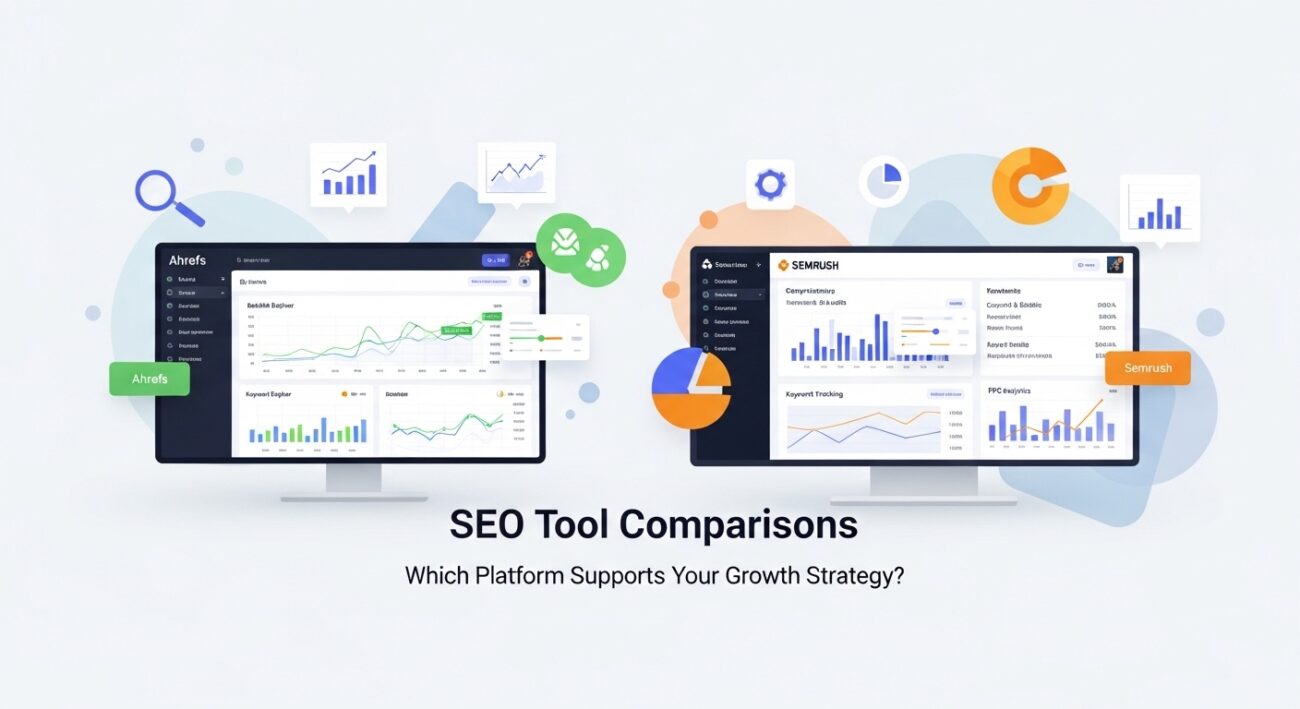
SEO tool comparisons balance data depth vs usability, as SEO data platforms like Ahrefs and Semrush deliver keyword intelligence and backlink analysis essential for growth strategies. Ahrefs prioritizes precise backlink data and intuitive interfaces for quick insights, suiting solo SEO workflows with cleaner dashboards and generous limits. Semrush offers broader data depth across PPC, audits, and AI features for comprehensive agency workflows, though its denser interface demands more expertise.
Ahrefs vs Semrush
- Ahrefs: Superior backlink analysis (larger referring domains), accurate keyword explorer with ‘Clicks’ metric, simpler UI for solo users, generous project limits; pricing from $129/month, excels in link intersect and broken links.
- Semrush: Massive keyword database (27B+), daily rank tracking, advanced site audits and AI content tools; better for agencies with PPC integration, historical data to 2015; starts at $139.95/month.
Ahrefs fits streamlined solo analysis, while Semrush powers multifaceted agency strategies.
Productivity software comparisons: Which workspace tools improve team output
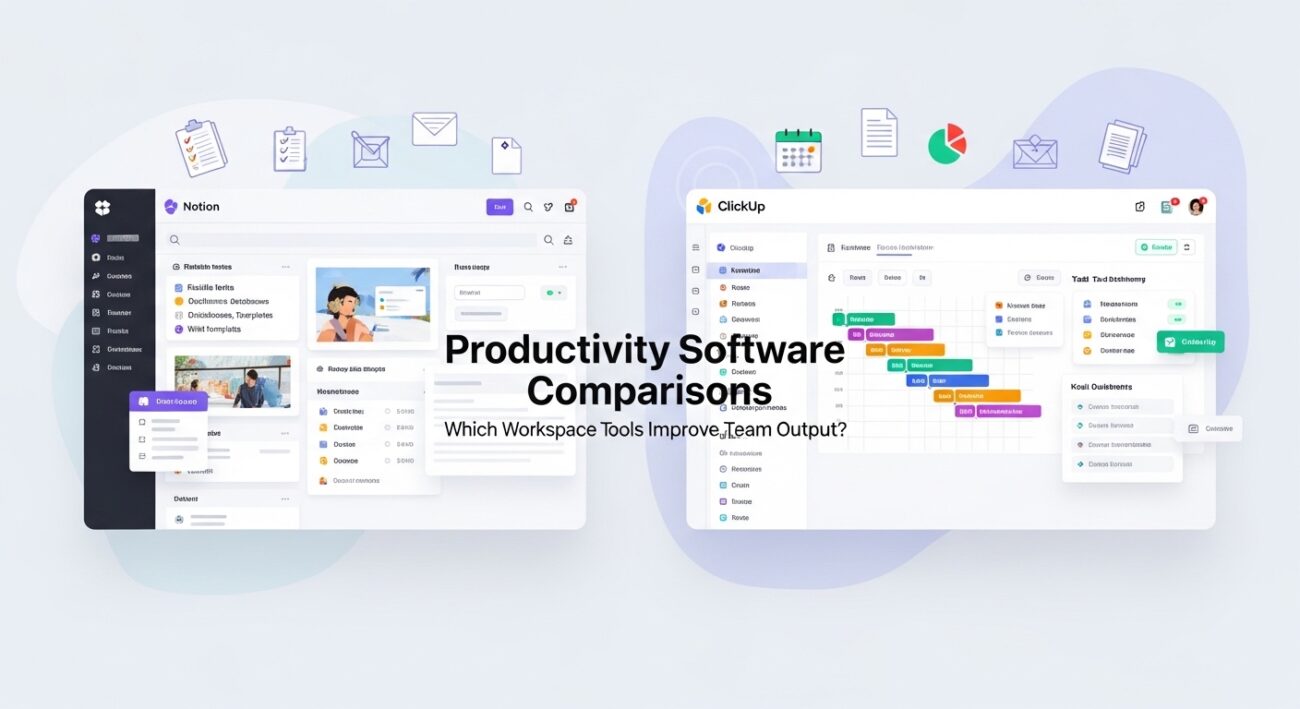
Productivity software comparisons focus on workflow productivity and team collaboration tools that streamline tasks, docs, and communication to boost output. Key factors include customization depth, automation capabilities, ease of adoption for teams, and integration with calendars or third-party apps—ClickUp excels in structured project tracking, while Notion prioritizes flexible all-in-one workspaces.
Notion vs ClickUp
- Notion: All-in-one for notes, databases, wikis; highly flexible with templates and AI autofill, ideal for creative teams and documentation; generous free plan (unlimited blocks), starts at $10/user/month; simpler UI but lighter on native task automations.
- ClickUp: Robust project management with Gantt, Kanban, automations, time tracking, and goal dashboards; suits structured workflows and larger teams; free tier with 100MB storage, from $7/user/month; steeper learning curve but more features for complex collaboration.
ClickUp drives output through task rigor, while Notion fosters fluid team creativity.
Business suite comparisons: Which workplace ecosystem supports company operations
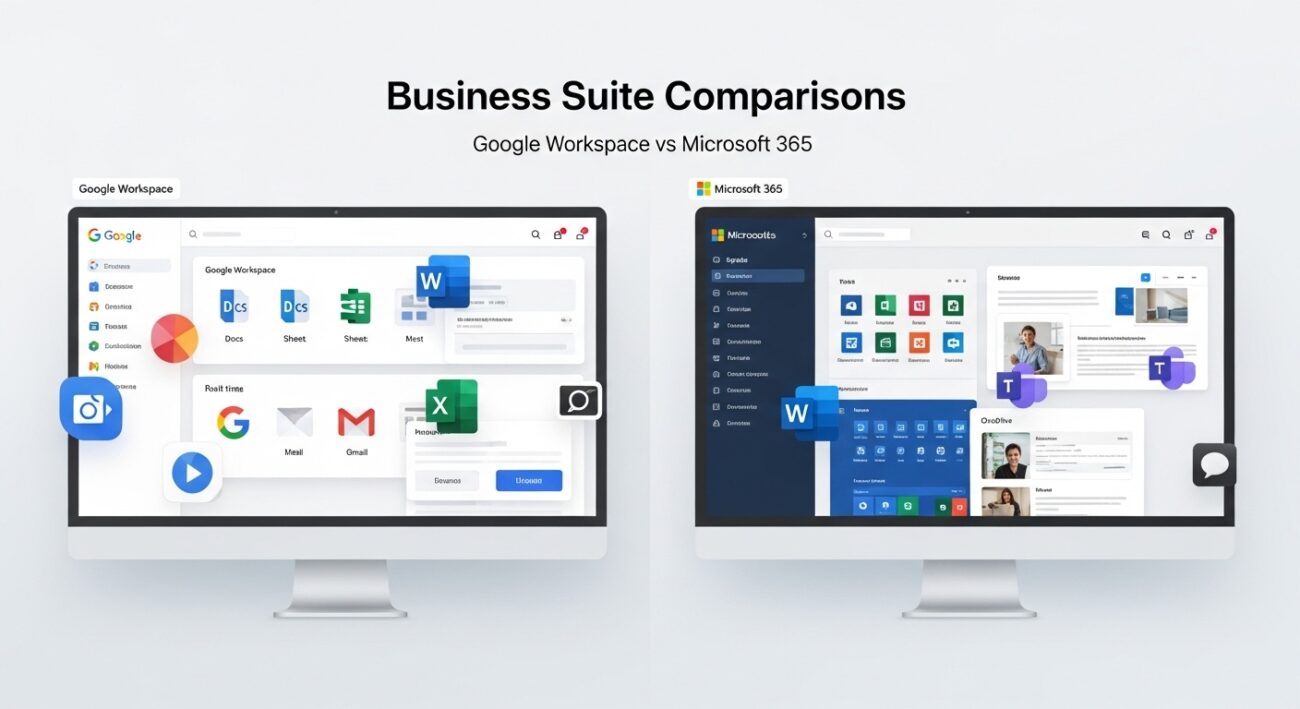
Business suite comparisons evaluate enterprise productivity suites that form the business communication stack for email, docs, collaboration, and file sharing to support seamless company operations. Google Workspace shines in real-time team editing and cloud simplicity, ideal for remote or creative workflows with intuitive tools like Docs and Meet. Microsoft 365 offers deeper desktop apps, advanced security, and offline reliability, suiting structured enterprises with complex data needs.
Google Workspace vs Microsoft 365
- Google Workspace: Cloud-first with real-time collaboration (multiple editors simultaneously), pooled storage (30GB–5TB), Gmail/Chat/Meet integration; starts at $6–$18/user/month, simpler for small teams.
- Microsoft 365: Robust desktop apps (Word/Excel/Teams), 1TB/user OneDrive, superior compliance/AI (Copilot); $6–$22/user/month, better offline access and enterprise integrations.
Google fosters fluid communication, while Microsoft powers rigorous operations.
Design software comparisons: Which visual content tool fits your creative workflow
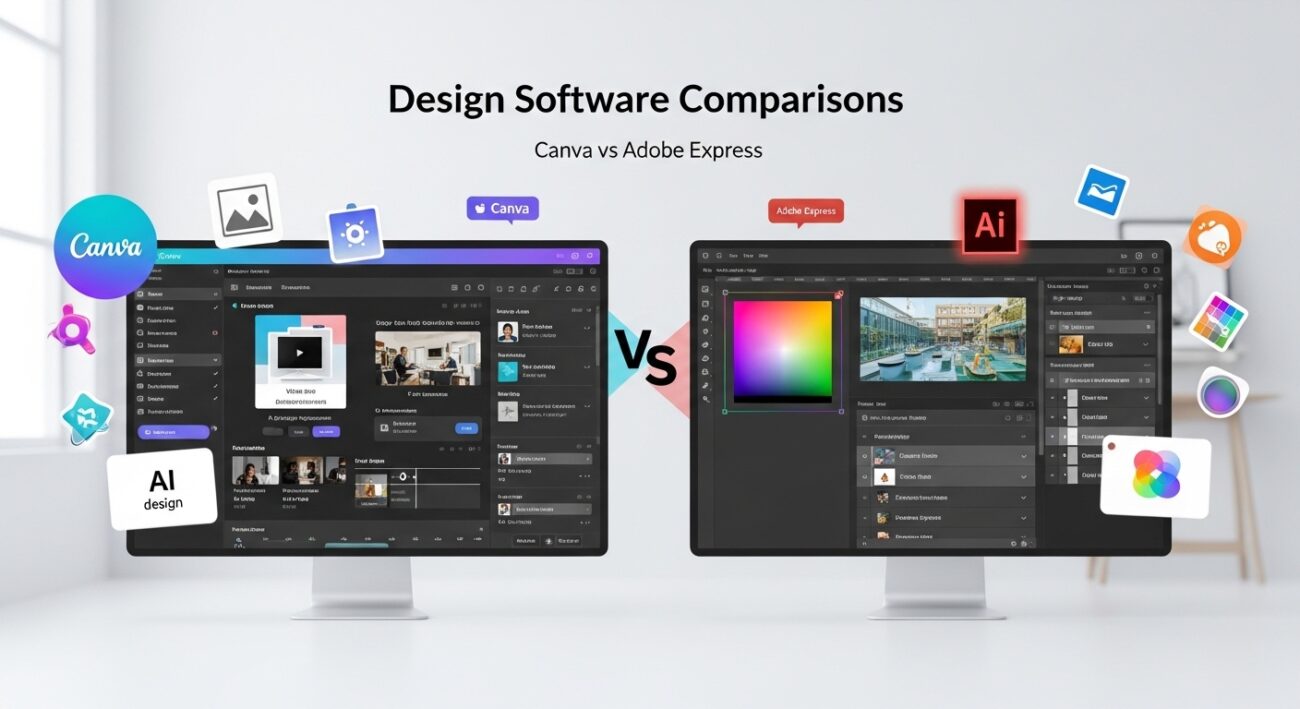
Design software comparisons weigh visual content software options like Canva and Adobe Express to match creative workflows, balancing template design tools, AI features, and collaboration ease. Canva leads with an expansive library of templates and intuitive drag-and-drop for rapid ideation, ideal for teams needing quick social graphics or presentations. Adobe Express emphasizes professional polish through Adobe ecosystem integration, superior layer control, and precise exports for refined outputs.
Canva vs Adobe Express
- Canva: Vast template ecosystem (more options), strong team collaboration, advanced video editing, AI tools like Magic Studio; free tier generous, Pro at $15/user/month; excels in speed for non-designers.
- Adobe Express: Cleaner layers/UI, unflattened PDF exports, premium Adobe stock (fonts/images), Firefly AI generation; cheaper solo ($9.99/month), seamless Photoshop sync; better for brand consistency.
Canva powers versatile team creativity, while Adobe Express suits precision-focused pros.
Customer support software comparisons: Which helpdesk platform scales with customer demand
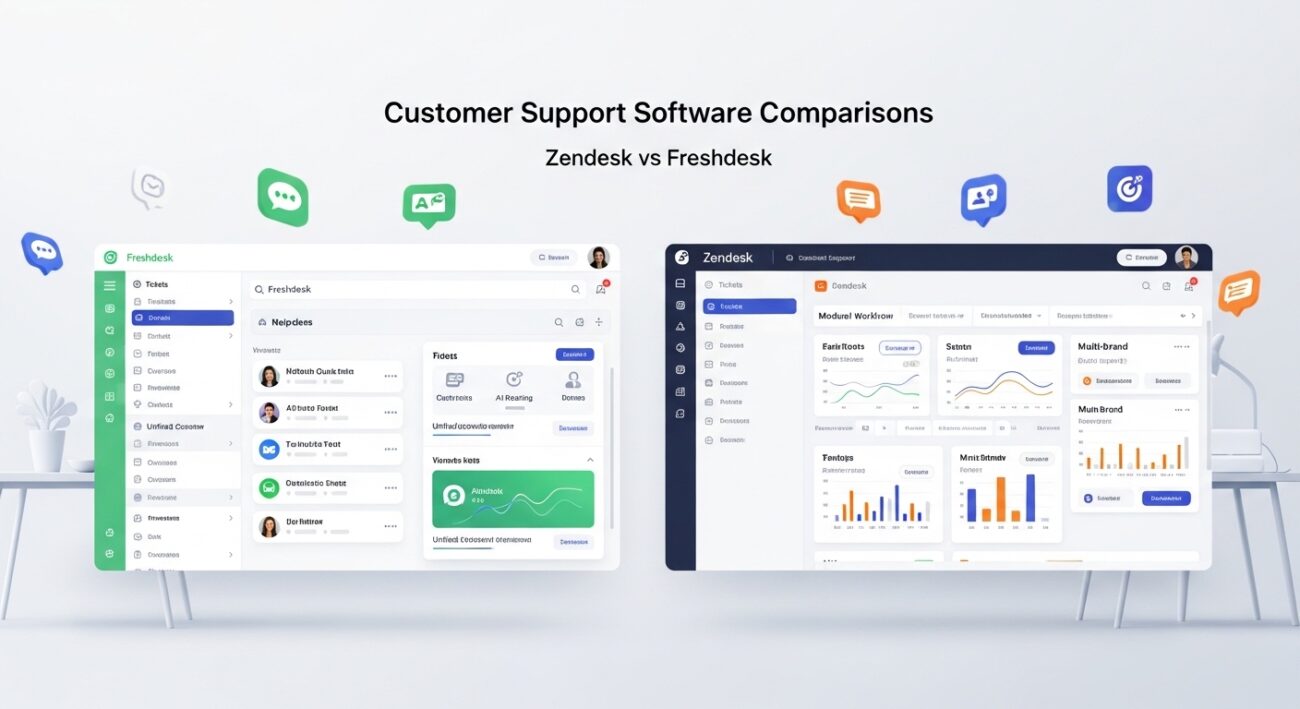
Customer support software comparisons center on ticketing platforms that incorporate customer service automation to handle rising demand efficiently. Key decision factors include omnichannel support, AI-driven routing, self-service portals, and scalability—platforms must evolve from SMB setups to enterprise volumes without workflow disruptions.
Zendesk vs Freshdesk
- Zendesk: Modular powerhouse for enterprises, deep customization in workflows/automation, robust analytics and multi-brand support; ideal for complex global operations; pricing starts ~$55/agent/month, steeper learning curve.
- Freshdesk: Intuitive all-in-one for SMBs scaling up, Freddy AI chatbots, quick onboarding, unified customer views; strong multi-channel with easier automations; free tier available, from ~$15/agent/month.
Freshdesk accelerates deployment for growing teams, while Zendesk masters intricate enterprise demands.
AI software comparisons: Which AI tools improve productivity, automation, and content creation
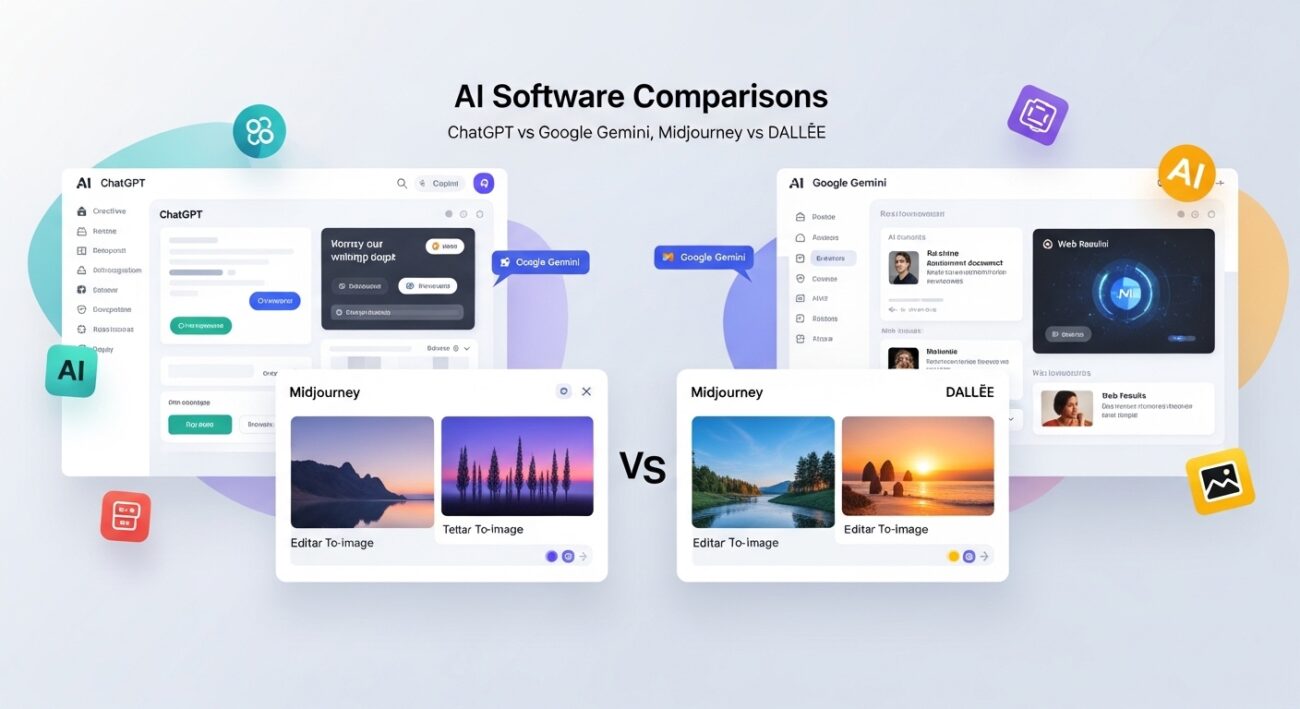
AI software comparisons evaluate tools across AI assistants, AI content tools, and AI image generation to enhance productivity, automation, and content workflows. ChatGPT excels in conversational depth and creative writing, powering versatile automation via custom GPTs, while Google Gemini leverages Google’s ecosystem for real-time research and multimodal tasks like document analysis. Midjourney dominates artistic image styles through Discord, contrasting DALL·E’s seamless text-to-image integration within ChatGPT for quick, editable outputs.
ChatGPT vs Google Gemini
- ChatGPT: Superior creative writing, coding assistance, custom GPTs for automation, 128K token context; free tier with GPT-3.5, Plus at $20/month for GPT-4o; excels in structured content and plugins.
- Google Gemini: Real-time web access, 1M+ token context for long docs, native Google Workspace integration, strong research with sources; free Gemini Pro, Advanced $20/month; better for academic queries and speed.
Midjourney vs DALL·E
- Midjourney: Stunning artistic renders, community prompts via Discord, v6+ models for details; subscription $10–$120/month; ideal for pros seeking stylized visuals.
- DALL·E: Integrated in ChatGPT, editable generations, precise text rendering; included in Plus tier; suits rapid prototyping and beginners.
ChatGPT drives broad productivity, Gemini powers research-heavy automation.
How to use this comparison hub to choose the right software faster
This comparison hub streamlines software selection by presenting side-by-side evaluations across CRM, ecommerce, SEO, productivity, design, support, and AI categories, highlighting key trade-offs in features, pricing, and scalability. Use it as a software decision checklist to match tools to your business workflow without endless research.
Tool Evaluation Workflow Checklist
- Budget range: Identify monthly costs (e.g., free tiers like HubSpot vs enterprise pricing like Salesforce at $55+/agent) and factor in scaling fees or transaction charges.
- Team size: Prioritize solo-friendly interfaces (Pipedrive, Canva) for individuals, collaborative features (ClickUp, Google Workspace) for teams, or enterprise-grade compliance (Zendesk, Microsoft 365) for 50+ users.
- Integration needs: Seek native compatibility for your stack—Shopify’s app ecosystem or Semrush’s PPC tools—ensuring tool compatibility with existing CRM, email, or analytics.
- Automation requirements: Evaluate AI-driven workflows like Freddy in Freshdesk or ChatGPT custom GPTs for repetitive tasks, balancing depth vs simplicity.
- Data ownership needs: Choose self-hosted (WooCommerce) for full control or hosted (Shopify) for managed security, reviewing migration policies.
- Learning curve tolerance: Opt for intuitive UIs (Notion, Freshdesk) if time-poor, or customizable powerhouses (Ahrefs, Zendesk) for experts.
Follow sequentially for faster, confident decisions.
Which sales CRM comparison helps teams choose between pipeline simplicity and customizable sales workflows
Zoho CRM vs Pipedrive helps SMB teams weigh pipeline simplicity against customizable sales workflows in pipeline CRM tools. For sales team adoption speed, Pipedrive excels with its intuitive drag-and-drop interface and visual pipelines, enabling fast onboarding and immediate SMB sales process optimization—ideal for small teams prioritizing sales process automation over complexity.
Businesses should favor Pipedrive’s ease when quick wins matter, like transactional sales where reps need minimal training. Conversely, prioritize Zoho CRM’s deeper workflow customization—custom fields, rules, and multi-pipeline logic—for sales workflow software handling complex cycles or cross-department needs, despite longer setup. This Zoho CRM vs Pipedrive comparison accelerates SMB CRM selection by matching tool depth to adoption tolerance.
Which CRM comparison explains sales pipeline management software vs marketing automation driven CRM systems
Pipedrive vs Infusionsoft clarifies sales pipeline CRM versus marketing lifecycle automation in lead management software. Deal tracking shines in Pipedrive’s visual pipelines, prioritizing sales pipeline focus for revenue operations tools where reps drag deals through stages—ideal for SMBs optimizing close rates over broad nurturing.
Choose Pipedrive when lead nurturing is secondary to pipeline velocity. Conversely, Infusionsoft (Keap) excels in lifecycle automation with drip campaigns and behavior triggers, suiting businesses blending sales with marketing workflows where revenue operations demand integrated funnels. This Pipedrive vs Infusionsoft comparison guides selection by workflow emphasis.
Which ecommerce platform comparison explains hosted ecommerce platforms vs self hosted store infrastructure
WooCommerce vs Shopify explains hosted ecommerce platforms versus self-hosted ecommerce stacks in online store infrastructure. Hosted SaaS ecommerce benefits like Shopify deliver convenience through automatic updates, PCI compliance, scalability, and zero technical maintenance responsibility—ideal for rapid launches without dev teams.
Self-hosted customization control defines WooCommerce, offering full code access, 59,000+ plugins, and ecommerce platform ownership for bespoke features and SEO mastery, but requiring hosting management, security patches, and performance tuning. Choose hosted for simplicity and scalability; self-hosted when control trumps convenience. This WooCommerce vs Shopify comparison clarifies trade-offs in ownership and upkeep.
Which SEO tool comparison helps marketers choose between backlink intelligence platforms and full marketing SEO suites
Ahrefs vs Semrush distinguishes backlink intelligence tools from full SEO data platforms in keyword research software and search marketing analytics. Marketers prioritizing raw backlink analysis depth should choose Ahrefs for its superior referring domain index, precise link intersect tools, and cleaner competitive research workflows—ideal when link-building drives strategy.
Opt for Semrush’s keyword research ecosystem and broader capabilities when needing all-in-one platforms with site audits, PPC data, daily rank tracking, and AI content tools for comprehensive workflows. Ahrefs suits data-focused link specialists; Semrush powers diverse agency needs. This Ahrefs vs Semrush comparison clarifies prioritizing depth versus breadth.
Which productivity tool comparison explains knowledge workspace software vs structured project management tools
Notion vs ClickUp reveals knowledge workspace tools versus project management productivity software for team collaboration platforms. Knowledge management workflows thrive in Notion’s flexible block-based system—ideal for wikis, databases, and documentation where teams build interconnected pages without rigid structure.
Choose structured task execution systems like ClickUp when needing Gantt charts, automations, time tracking, and hierarchical task views in workflow organization software—perfect for deadline-driven projects demanding accountability over freeform creativity. Notion suits documentation-first teams; ClickUp powers execution-focused squads. This Notion vs ClickUp comparison clarifies team collaboration structure differences.
Which business suite comparison helps companies choose between cloud productivity ecosystems for communication and document workflows
Google Workspace vs Microsoft 365 comparison guides companies through business productivity suites for workplace collaboration ecosystems, highlighting company communication infrastructure differences. Google Workspace prioritizes real-time email and communication infrastructure via Gmail, Chat, and Meet with seamless document collaboration architecture—multiple users editing Docs simultaneously with live cursors, ideal for distributed teams valuing speed over complexity.
Microsoft 365 emphasizes enterprise cloud office software depth, offering desktop-first Outlook with 50GB mailboxes, track-changes in Word/Excel, and superior security/enterprise admin controls like Intune compliance—better for regulated industries needing granular IT oversight. Google fosters fluid workflows; Microsoft ensures robust control. This Google Workspace vs Microsoft 365 clarifies ecosystem trade-offs.
Which design tool comparison helps creators choose fast template based design tools vs simplified professional editing platforms
Canva vs Adobe Express guides creators through visual content creation tools, contrasting template design software speed with digital graphic editing platforms depth in marketing design workflows. Template driven design workflows dominate Canva, where vast libraries and drag-and-drop enable rapid social content production workflows—social graphics, presentations, and videos created in minutes for non-designers prioritizing brand asset creation volume.
Choose Adobe Express for simplified professional editing platforms when needing layer control, precise exports (unflattened PDFs), and Adobe ecosystem integration for refined outputs beyond templates. Canva accelerates bulk marketing; Express elevates quality. This Canva vs Adobe Express comparison clarifies speed versus editing capability trade-offs.
Which helpdesk software comparison explains modern customer support ticketing systems and automation driven service platforms
Zendesk vs Freshdesk contrasts customer support platforms by comparing ticketing automation software depth with helpdesk service management breadth in customer experience software. Zendesk delivers advanced ticketing workflow automation through complex routing rules, triggers, and SLA management—essential for enterprise support analytics and reporting across high-volume, multi-team operations.
Freshdesk prioritizes customer service channel integration with Freddy AI chatbots, unified inboxes spanning email/chat/social, and simpler automations for faster omnichannel deployment—ideal for SMBs scaling support without heavy configuration. Zendesk suits intricate workflows; Freshdesk accelerates unified service. This Zendesk vs Freshdesk comparison reveals automation versus integration priorities.
Which AI assistant comparison helps users choose between AI productivity assistants for research, writing, and workflow automation
ChatGPT vs Google Gemini comparison empowers users to select AI productivity assistants by contrasting generative AI software tools for AI research workflows, AI writing and productivity use cases, and enterprise AI integration potential in AI workflow automation. ChatGPT dominates creative writing, custom GPTs for tailored automation, and conversational depth—ideal for content teams and individual productivity where human-like responses drive daily tasks.
Google Gemini excels in AI research workflows with real-time web access, massive context windows for document analysis, and native Google Workspace integration, suiting enterprise AI tools needs like academic research or data-heavy operations. ChatGPT fuels versatile automation; Gemini powers research precision. This ChatGPT vs Google Gemini clarifies ecosystem strengths for smarter selection.
Which AI image generator comparison explains creative AI image generation workflows and artistic control differences
Midjourney vs DALL·E illuminates AI image generation tools differences in generative art platforms and text to image AI models for AI creative workflow software. Midjourney empowers creative output control vs automation through Discord-based parameters, style weights, and iterative refinements—ideal for artists seeking artistic style control in complex compositions where prompt interpretation differences demand nuanced tweaks.
Choose DALL·E for prompt-based image generation simplicity within ChatGPT, excelling in AI art workflow differences like rapid prototyping, precise text rendering, and editable outputs without community friction. Midjourney suits stylized experimentation; DALL·E streamlines accessible creation. This Midjourney vs DALL·E comparison clarifies control versus convenience trade-offs.
Final Thought
This comparison hub eliminates software selection overwhelm by distilling trade-offs across categories into actionable insights. Match tools to your workflow—Pipedrive for pipeline speed, Semrush for marketing breadth, ClickUp for task rigor—using the checklist to balance budget, team size, and automation needs. Prioritize fit over features; the right stack compounds productivity daily.