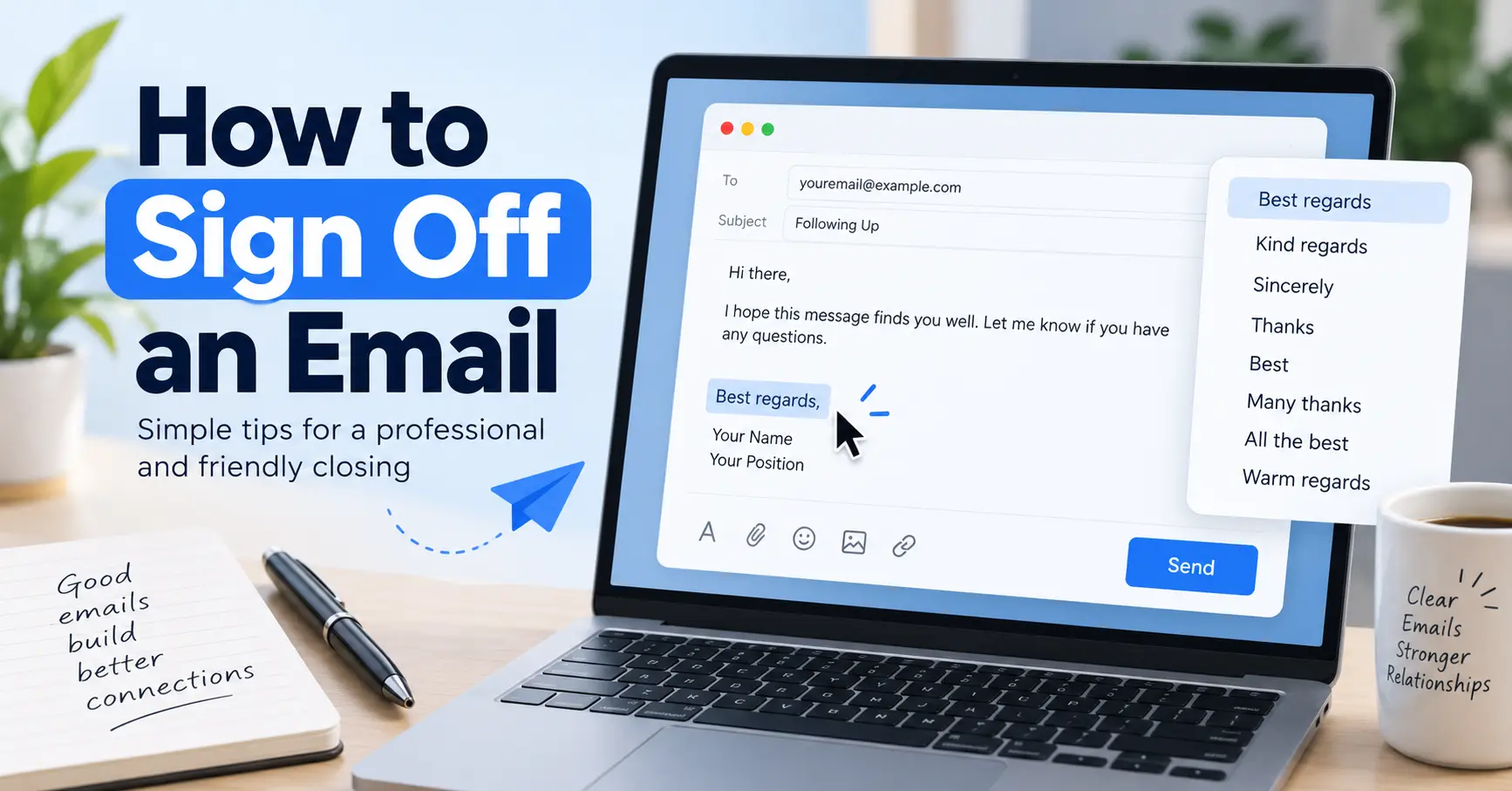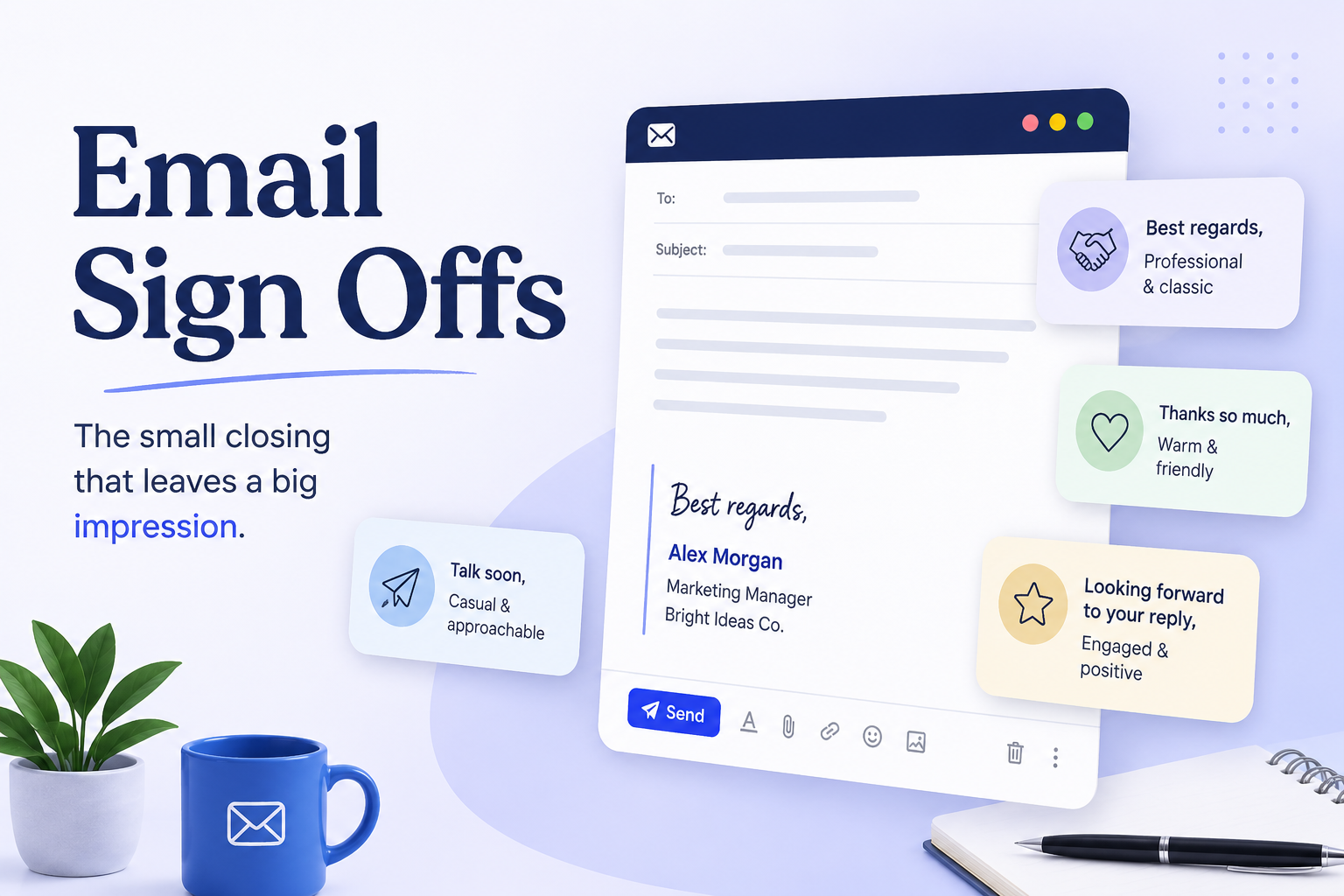
An email sign off is the short closing phrase before your name. Choosing the right one depends on your relationship with the recipient, the tone of your email, your industry, and the situation. “Best regards” and “Thank you” work in most professional settings. Formal emails call for “Sincerely” or “Respectfully.” Casual workplace emails welcome “Cheers” or “All the best.” Matching your sign off to the situation always leaves a stronger, more professional impression.
You just finished writing a great email. The subject line is strong. The body is clear. But now you are stuck on the last line. Should you write “Best regards,” “Thanks,” or just your name? That final phrase matters more than most people think. The right email sign off sets the tone, builds trust, and leaves the reader with a good impression. The wrong one can make even a well-written email feel awkward.
This guide covers 60+ email sign off examples organized by formality, situation, and industry. You will also get a clear framework for choosing the right closing phrase every single time.
What Is an Email Sign Off?
An email sign off is the short closing phrase you write just before your name at the end of an email. It signals the end of your message and sets the final tone. Common examples include “Best regards,” “Sincerely,” and “Thank you.” It is also known as a valediction in formal writing.
Many people mix up the email sign off with the email signature. They are not the same thing. The sign off is just the closing phrase, like “Kind regards.” The email signature is the full block below your name that includes your job title, company name, phone number, and contact details. They work together, but they serve different purposes. Understanding this distinction helps you use both correctly in every professional email you send.
How Do You Choose the Right Email Sign Off?
Choosing the right email closing phrase comes down to four factors: your relationship with the recipient, the tone of your email, your industry, and the specific situation. When all four align with your sign off, the email feels complete and appropriate. When they do not, even a good email can feel off.
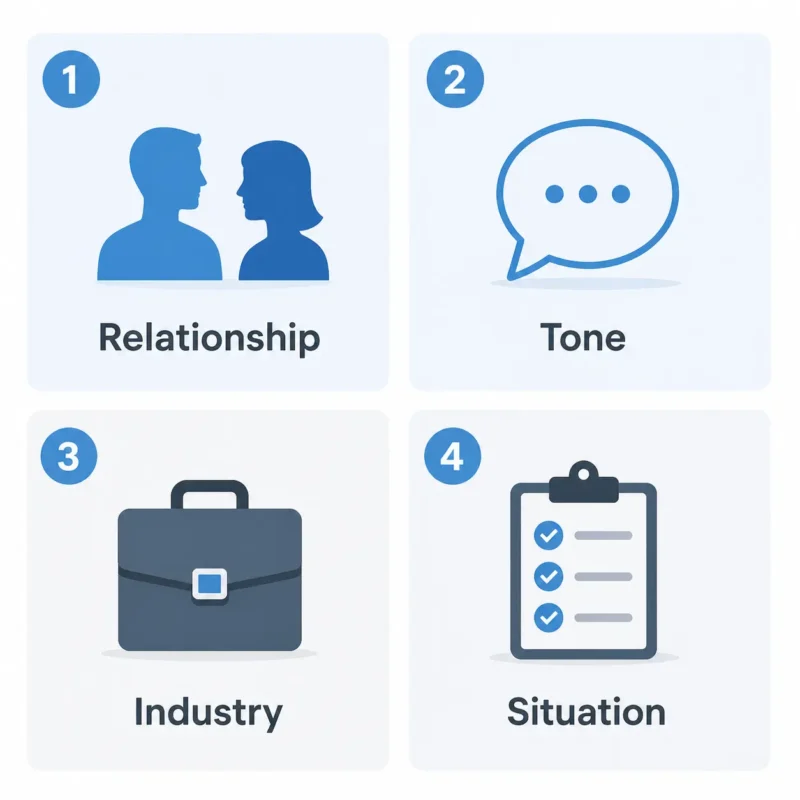
Here is how each factor works:
- Relationship – Are you writing to a new client, your manager, or a close colleague? New contacts and formal relationships need polished closings. Close colleagues are fine with shorter or warmer ones.
- Tone – If your email is formal, your sign off should match. A relaxed back-and-forth with a coworker does not need a stiff closing.
- Industry – Legal professionals lean on “Respectfully.” Creative teams are comfortable with “Cheers.” Healthcare and education stay in the professional middle ground.
- Situation – A thank you email, a job application, an apology, and a cold outreach email all carry different emotional needs. Your closing phrase should reflect the moment.
When you are not sure which to use, ask yourself: “Would this feel right if I handed this email to the recipient in person?” If the answer is yes, you have found your closing.
What Are the Best Professional Email Sign Offs?
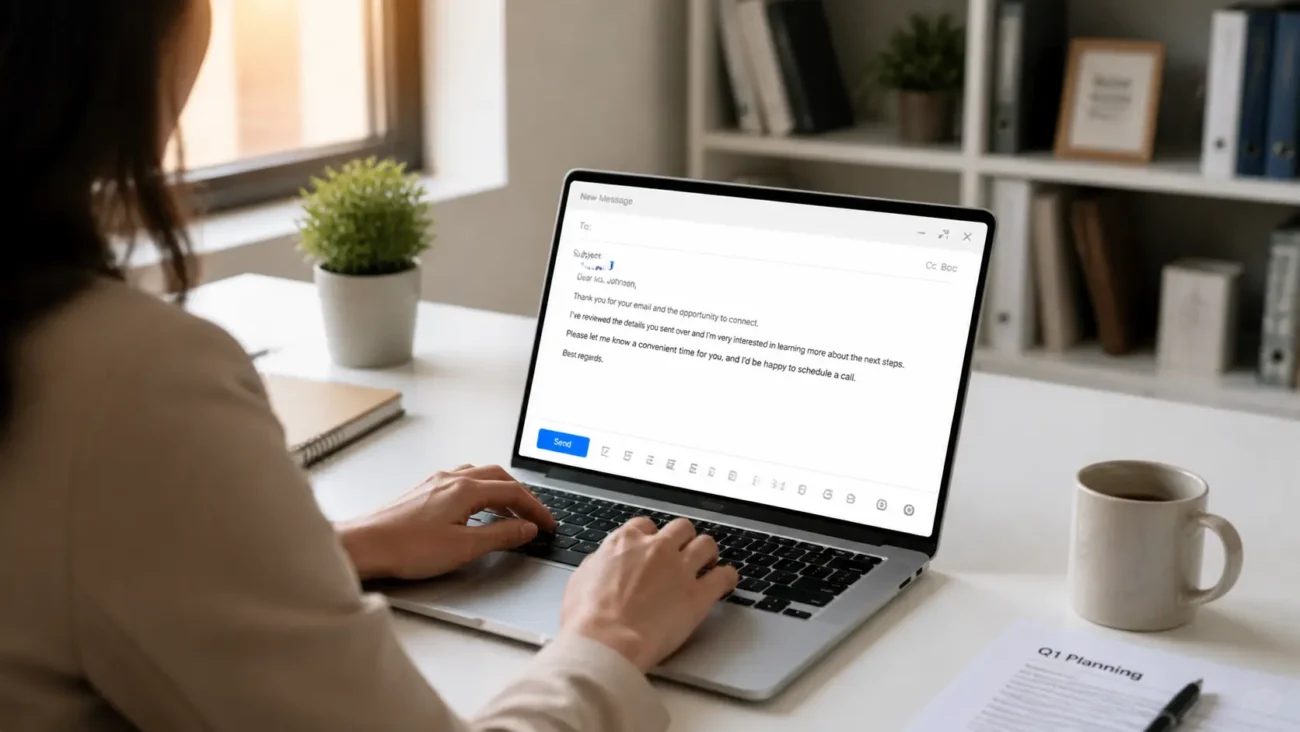
The best professional email sign offs are ones that feel polished, warm, and appropriate for business communication. Options like “Best regards,” “Kind regards,” “Thank you,” and “Sincerely” work across most professional contexts because they are respectful, clear, and universally understood.
Most of your emails will fall into the professional category. These include emails to clients, managers, vendors, new contacts, and anyone you do not know well yet.
General Professional Sign Offs
These email closing phrases work in almost every professional context. They are safe, respected, and widely used in business email communication.
- Best regards – Warm and professional. Works with new contacts and ongoing clients.
- Kind regards – Slightly softer than “Best regards.” A great choice for support emails or first-time contact.
- Best – Short and friendly. Suitable for people you have emailed before.
- Thank you – Shows appreciation. Ideal when making a request or thanking someone for their help.
- Warm regards – A little more personal but still fully professional.
- With appreciation – Expresses genuine gratitude while staying businesslike.
- All the best – Positive and widely accepted across cultures and age groups.
Formal Professional Sign Offs
Use these when writing to senior executives, new clients, government contacts, or any situation that calls for high professional standards.
- Sincerely – Classic and formal. The gold standard for official business communication.
- Respectfully – Conveys deep respect. Especially common in legal and government writing.
- Cordially – Formal but not cold. Good for building new professional relationships carefully.
- Yours sincerely – Traditional and widely used in British and Commonwealth business writing.
What Are Good Casual Email Sign Offs for Colleagues?
Casual email sign offs like “Cheers,” “Thanks again,” and “Take care” work well with colleagues you already know. They feel warm and natural in relaxed workplace cultures. The key is to match the informality level to your actual relationship with that person.
Not every work email needs a polished formal closing. When you are writing to a teammate, a coworker on a quick update thread, or anyone in a relaxed creative environment, a casual sign off feels more natural and human.
- Cheers – Friendly and widely used in creative industries, startups, and Australian workplaces.
- Thanks again – Informal gratitude. Great for follow-up messages.
- Take care – Shows warmth and genuine care for the recipient.
- Talk soon – Signals ongoing communication. Works well with close working contacts.
- Have a good one – Casual and cheerful. Fine for relaxed teams but too informal for formal emails.
- Catch you later – Very casual. Reserve this for colleagues you message every day.
A good rule to follow: if you would say it out loud in a friendly office conversation, it is probably fine in email. If you would not say it to your manager in a meeting, do not write it to them in an email either.
Which Email Sign Off Fits Your Situation?
The situation of your email matters just as much as your relationship with the recipient. A job application, a cold outreach email, and an apology email all need different closing phrases. Matching your sign off to the situation shows emotional awareness and strong communication skills.
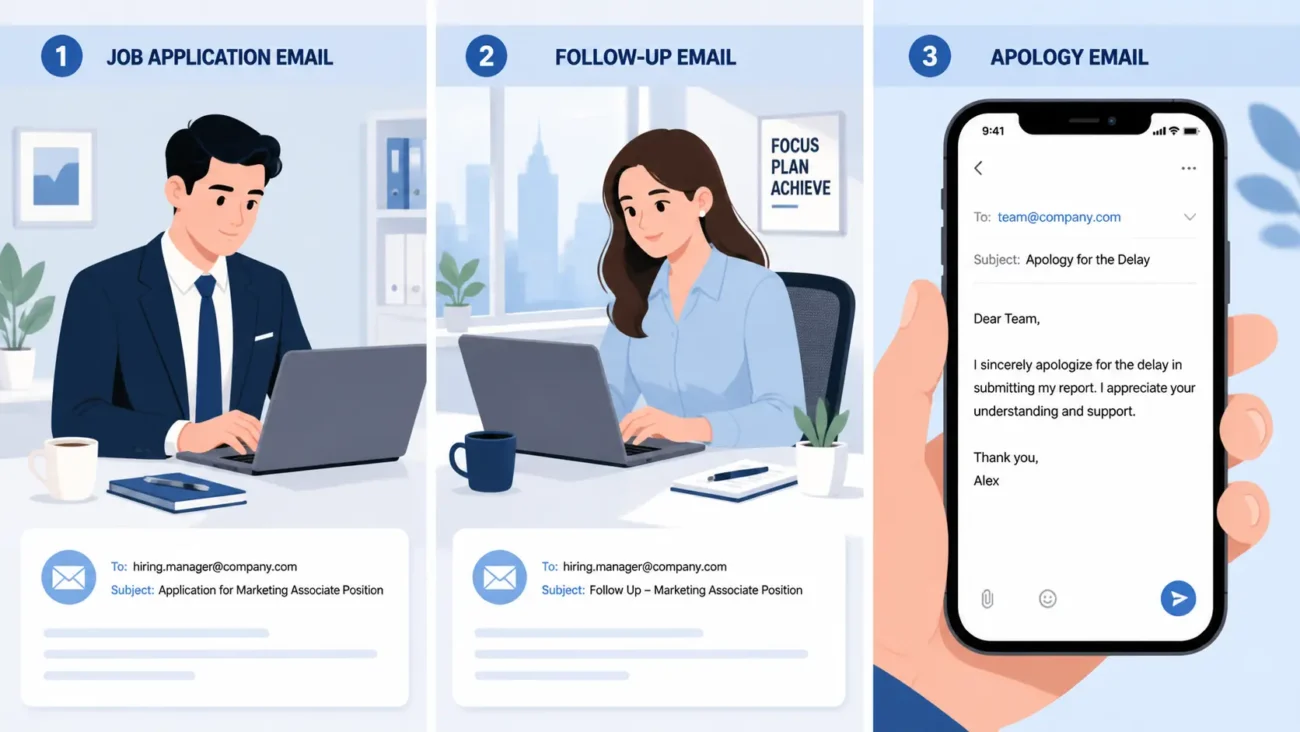
Here is a breakdown by common email situation.
Follow-Up Emails
When following up after a meeting, a proposal, or a previous message, your closing should signal openness and continued interest.
- Looking forward to your thoughts
- Looking forward to hearing from you
- Appreciate your time
Thank You Emails
When your whole email is about gratitude, your sign off should reinforce that feeling.
- With gratitude
- Many thanks
- Appreciatively
Job Application Emails
Job application emails need a closing that signals respect, professionalism, and genuine interest in the role.
- Thank you for your consideration
- I look forward to speaking with you
- Best regards
Apology Emails
When you are apologizing, your sign off should match the seriousness of the message.
- Sincerely sorry
- With deepest apologies
- Regretfully
Cold Outreach Emails
Cold email closings need to feel confident and inviting without being pushy. Closings with a forward-looking phrase tend to encourage replies more effectively in cold email communication.
- Looking forward to connecting
- Best
- Thanks for your time
Holiday and Seasonal Emails
Workplace holiday emails benefit from a warmer, slightly personal tone that still feels professional.
- Warm wishes
- Season’s greetings
- With warm regards
How Do Email Sign Offs Differ by Industry?
Your industry shapes what “professional” means in email communication. A sign off that feels normal in a creative agency can seem too casual in a law office. Knowing the norms of your industry helps you choose a closing phrase that fits the culture and expectations of your field.
Here is a quick guide to email sign offs by sector.
Corporate and Business
Corporate email communication values reliability and consistency. Stick to trusted, clean sign offs.
- Best regards
- Sincerely
- Thank you
Creative Industries
Creative professionals use warmer and more expressive language. Slightly casual closings are normal and even expected in this space.
- Cheers
- Best
- Talk soon
Legal
Legal emails demand precise, formal, and respectful language at all times.
- Respectfully
- Cordially
- With appreciation
Healthcare
Healthcare communication balances warmth with professionalism. Clear and calm sign offs work best in this field.
- Kind regards
- With warm regards
- Thank you
Education
Teachers, professors, and school administrators benefit from sign offs that feel approachable but still authoritative.
- Best regards
- Thank you for your time
- Sincerely
Which Email Sign Offs Should You Avoid?
Avoid sign offs that come across as passive-aggressive, too casual, or grammatically careless. Phrases like “Thanks in advance” can pressure the recipient before they have agreed to anything. Abbreviations like “Rgds” look rushed and unprofessional. Choosing the wrong closing can quietly undermine an otherwise well-written email.
Here are the specific sign offs to avoid in professional email communication.
- Thanks in advance – This quietly pressures the recipient to say yes before they have decided. Use “Thank you” instead.
- See ya! or Later, dude – Too casual for any professional setting.
- Love or XOXO – Only for personal emails. Never appropriate in business communication.
- Thx or Rgds – Abbreviations make you look careless. Always write the full word.
- Yours truly – This phrase feels awkward and old-fashioned in modern business email.
- No sign off at all – Skipping the closing entirely feels abrupt, especially with new contacts. Always include at least “Best” or “Thanks.”
A simple test: read your closing out loud. If it sounds strange, sarcastic, or too blunt, choose something else before you send.
Do Email Sign Offs Differ by Culture or Generation?
Yes. Email sign off norms vary significantly by country and age group. What feels standard in Australia may seem too casual in the United States. Baby Boomers tend to prefer formal closings, while Gen Z often uses very minimal sign offs in digital-first workplaces. Knowing these differences helps you communicate more effectively with any audience.
Cultural Differences
In Australia, “Cheers” is a standard professional sign off used across many industries without any informal connotation. In the United States, the same word can feel too relaxed unless the overall email tone is already casual.
In many European countries, particularly in formal business sectors, longer and more elaborate closings are completely normal. In German and French business correspondence, phrases expressing ongoing goodwill are widely accepted. In the United Kingdom, “Yours sincerely” and “Yours faithfully” remain widely used in formal writing.
American business email culture tends to favor shorter, cleaner sign offs like “Best” or “Thanks.”
Generational Differences
Baby Boomers generally prefer traditional and formal closings like “Sincerely” or “Best regards.” They grew up with formal letter-writing norms and carry those habits into email.
Millennials are comfortable across a wide range of closings, from “Best regards” in formal contexts to “Thanks!” in casual ones.
Gen Z professionals, who entered the workforce in a digital-first environment, often use very minimal closings or skip them entirely in internal messaging-heavy workplaces. In more formal contexts, they default to “Best” or “Thanks” as safe options. As remote work and async communication have expanded through 2025 and 2026, many professionals across all age groups are shifting toward shorter, warmer closings that still feel human and professional.
What Are the Best Practices for Email Sign Offs?
The best practices for email sign offs come down to matching your tone, capitalizing only the first word, keeping it short, and always writing words in full. Following these simple rules ensures your email closes on the right note every time.
Follow these eight rules to get your email closing phrases right consistently.
- Match the tone of your email – Formal email, formal sign off. Relaxed email, relaxed sign off. Mismatched tone is the most common mistake.
- Capitalize only the first word – Write “Kind regards” not “Kind Regards.” This is a standard grammar rule many people get wrong.
- Keep it short – A good sign off is one to three words. It is not a place to start a new thought.
- Never use abbreviations – Always write the full word. “Rgds” and “Thx” look rushed and unprofessional.
- Add a comma after the sign off – Proper email etiquette includes a comma after the closing phrase, before your name.
- Consider the recipient first – Ask: what would feel right to this specific person in this specific situation?
- Stay on brand – If you are writing on behalf of a company, your closing should match the company’s communication style.
- When in doubt, play it safe – “Regards” or “Best” will never hurt you. Unusual sign offs can, especially with new contacts.
Quick Reference: Email Sign Offs by Situation
Use this table to find the right email closing phrase without having to read the whole guide again.
| Situation | Recommended Sign Offs |
| New client or formal contact | Sincerely, Best regards, Kind regards |
| Ongoing professional relationship | Best, Best regards, Thank you |
| Follow-up email | Looking forward to hearing from you, Best regards |
| Job application | Thank you for your consideration, Best regards |
| Thank you email | With gratitude, Many thanks, Appreciatively |
| Apology email | Sincerely sorry, Regretfully, With deepest apologies |
| Cold outreach | Best, Thanks for your time, Looking forward to connecting |
| Casual colleague | Cheers, Thanks again, Take care |
| Holiday or seasonal email | Warm wishes, With warm regards |
Final Thoughts
Getting your email sign offs right is one of the simplest ways to make every email feel more polished and intentional. You do not need to overthink it. Use the four-factor check: relationship, tone, industry, and situation. When those four things align with your closing phrase, you are done.
The more emails you send with intentional sign offs, the more natural the habit becomes. It is a small detail that builds a strong, consistent professional image over time. Every part of your message matters, from the subject line to the very last word.
If you want to keep improving your email communication skills, a great next step is learning how to send emails to multiple recipients without spam risk. Strong email habits are built one practice at a time, and every part of your message plays a role in how you are perceived.