The email drafts folder is the most powerful and underused safety net in your inbox. We have all felt that jolt of “send-panic”—the instant regret after firing off an email in anger or noticing a typo in the recipient’s name. The draft folder is the cure. It is a tool for intentional communication.
Your email draft is more than just an unsent message. It is a workspace. It is a “cooling-off” room. It is a template factory. Using it correctly can save you from professional embarrassment and save you hours of work.
Most people see their drafts folder as a digital graveyard of unfinished thoughts. This guide will teach you to see it as a productivity hub. We will cover what drafts are, the strategic benefits of using them, and a complete system for managing them efficiently.
What Is an Email Draft?
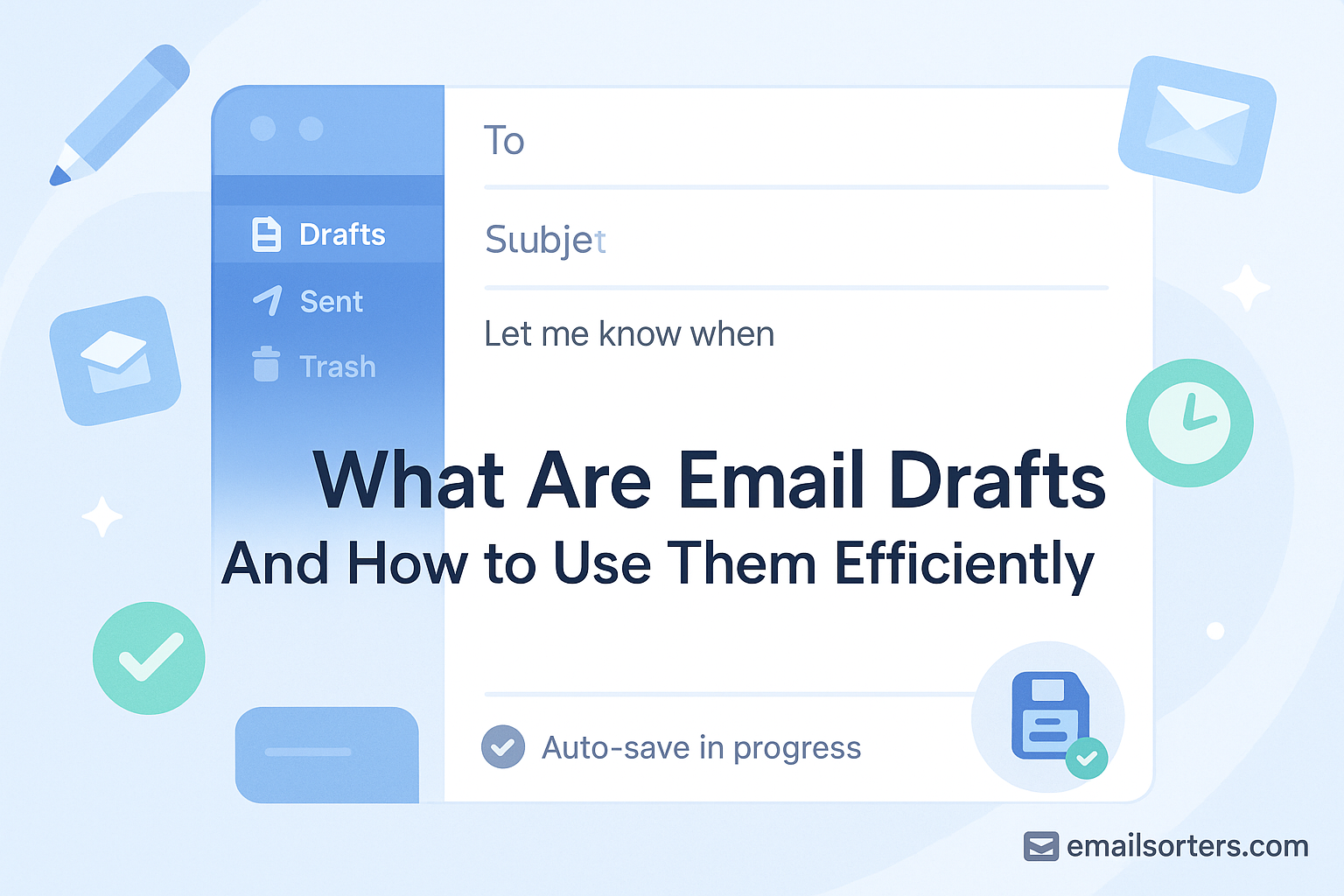
An email draft is a message that you have started writing but have not yet sent. It is saved in a special “Drafts” folder within your email account. This allows you to close the message and come back to it later without losing your work.
Think of it as the digital version of a letter you have written and set aside on your desk. You can review it, edit it, add attachments, or delete it entirely. It is a private, unsent file. It only becomes a “sent” email when you add a recipient and hit the “Send” button.
How Does an Email Draft Get Created?
An email draft is created in two ways: automatically or manually. Most modern email clients auto-save your work every 30 seconds to prevent data loss. You can also manually save a draft by closing the compose window.
- Automatic Saving: This is the magic you see in Gmail or Outlook. You start typing a new email. After a few seconds, a “Saving…” or “Draft saved” notice appears. If your browser crashes or you lose power, your work is safe. The email client is constantly updating the draft on the email server.
- Manual Saving: This is the intentional act of clicking the “Save” button or, more commonly, just closing the “New Message” window. Your email service will ask, “Save this draft?” By saving it, you are intentionally placing it in the drafts folder to finish later.
Where Is the Email Drafts Folder Located?
The email drafts folder is a default folder in every email client, located in the main navigation menu alongside your Inbox, Sent, and Trash folders.
Here is where to find it in the most common email clients:
- Gmail: In the left-hand menu, you will see “Drafts.” It often has a number next to it, showing how many drafts are inside.
- Outlook (Desktop & Web): In the folder pane on the left, “Drafts” is listed as a primary folder under your account.
- Apple Mail: In the “Mailboxes” sidebar, you will find a “Drafts” folder. You may have one for each account if you manage multiple accounts.
Why Are Email Drafts So Important? (The Strategic Benefits)
Email drafts are your primary tool for professional, intentional communication. They are not just for unfinished messages. They are a “pause” button that saves you from errors, a template-builder that saves you time, and a sync tool for a mobile workforce.
The “Cooling-Off Period”: How Drafts Prevent Disasters
This is the most critical function of the drafts folder. It provides a “cooling-off” period. When you receive a frustrating email, the urge is to reply immediately. Drafting the reply, saving it, and walking away for 30 minutes can save your job.
I once saw a colleague fire off an angry “Reply All” to a client. The email was emotional, full of blame, and failed to use CC and BCC correctly. The fallout was immediate and disastrous.
If that colleague had written the exact same email and just let it sit in the drafts folder, they would have re-read it an hour later and been horrified. They would have deleted it. The drafts folder is your emotional firewall.
The “Template Factory”: How Drafts Save Time
This is the biggest productivity hack for email drafts. Many of us write the same email over and over. “Here are our services,” “Thank you for your application,” “Here is the info you requested.”
You can store a perfectly-written version of each of these in your drafts folder. When you need one, you open the draft, copy the text, paste it into a new email, and personalize it. This turns a 10-minute task into a 30-second one.
The “Sync & Go”: Drafting Across Devices
This feature is a cornerstone of modern work. Because drafts are saved on the server, you can start a message on your desktop and finish it on your phone.
You can write a complex proposal at your desk. Then, on your way to the meeting, you can open your phone, proofread the draft, and hit “Send” at the perfect moment. This is simple to do when you set up email on your iPhone or Android device.
The “Complex Composition”: Writing Better Emails
Some emails are not quick replies. They are proposals, reports, or critical announcements. They require thought, attachments, and careful proofreading.
The drafts folder is your dedicated workspace. You can spend a few days composing a single email. You can add your research, check your links, and rewrite your opening. This is a far better space to work than a word processor, as all your email tools (like formatting and attachment) are right there. This is a big evolution from the early days of email, as we’ve seen since the fiftieth anniversary of email.
How to Use Email Drafts Efficiently (The “How-To”)
Having a drafts folder is one thing. Using it as a system is another. Here are practical, expert strategies for turning your drafts folder from a junk drawer into a command center.
Strategy 1: Create a Reusable Email Template Library
This is the number one strategy for anyone in a client-facing role.
- Identify Your Top 5: What are the 5 emails you write most often?
- Example: Sales intro, FAQ response, meeting follow-up, invoice reminder, application rejection.
- Draft a “Perfect” Version: Create an email account or use your current one. Write each email perfectly. Check for tone, grammar, and clarity. Use placeholders like
[CLIENT NAME]or[LINK]for parts you will customize. - Use a Clear Subject Line: Name the drafts with a clear, searchable subject line.
- Example:
TEMPLATE - FAQ Response (General) - Example:
TEMPLATE - New Client Intro
- Example:
- How to Use Them: When you need a template, DO NOT FORWARD OR REPLY to the draft. This can create a messy thread.
- Open the draft.
- Select all (Ctrl+A) and Copy (Ctrl+C).
- Compose a new email.
- Paste (Ctrl+V) the text.
- Personalize and send.
Strategy 2: The 30-Minute “Cool-Down” Rule
This is a non-negotiable personal policy for professional communication.
- The Rule: If an email makes you feel angry, frustrated, or defensive, you are forbidden from hitting “Send.”
- The Process:
- Write the entire, emotional, no-holds-barred reply. Get it all out.
- Click the “Save” icon or just close the window.
- The email is now safe in your drafts folder.
- Go for a 30-minute walk. Get coffee. Talk to a co-worker.
- When you return, open the draft. You will almost certainly delete it and write a calm, professional, and much shorter reply.
Strategy 3: Batching Your Email Responses
“Batching” is a classic productivity technique. It means you do all similar tasks in one block of time. The drafts folder is perfect for this.
- Set “Triage Time”: Spend 15 minutes in your inbox. Your goal is not to reply, but to sort.
- Open & Draft: Open an email that needs a thoughtful reply. Start drafting the response. Get your main thoughts down.
- Save & Close: Save the draft. Move to the next email.
- Repeat: Do this for 5-10 emails. They will all be sitting in your drafts folder.
- Set “Reply Time”: Later in the day, go to your drafts folder. You can now finish, polish, and send all 10 replies in one focused session.
Strategy 4: Using Drafts as a “Handoff”
In a team setting, drafts are great for collaboration.
- An assistant can draft a reply for their executive.
- A junior team member can draft a client response and ask a manager to review it.
- The manager can open the draft, make edits, and send it themselves.
This keeps the conversation in one place and prevents messy “Fwd: Fwd: Fwd:” chains. This is common with a shared family email account, where one person drafts a reply about a bill and the other reviews it.
What Should You Not Use Email Drafts For? (The Mistakes)
Your drafts folder is not a storage unit. Using it for the wrong purpose clogs your system, eats server space, and can even be a security risk.
Mistake 1: Using Drafts as a To-Do List
A drafts folder is a terrible to-do list. It has no due dates, no reminders, and no priority settings.
It is fine to start a draft as a quick note (e.g., subject: “Call Bob”). But do not let it live there. This is a common path to a cluttered folder with 500 (no subject) items.
What to do instead: Use a real task manager (like Google Tasks, Todoist, or Microsoft To Do).
Mistake 2: Using Drafts as a File Storage System
I have seen this. A person wants to move a file from their work computer to their home computer. They create an email account for themselves, start a draft, and attach a 20MB file. Then they just leave it there.
This is a bad idea. It eats up your email storage quota. It can cause sync issues. This is what cloud storage (like Google Drive or OneDrive) is for. It is also what email folders are for.
Mistake 3: Letting Your Drafts Folder Become a Mess
A drafts folder with hundreds of old, unfinished messages is useless. It is a “digital graveyard.”
You must clean your drafts folder. Once a month, go to your drafts folder. Sort by “Oldest.” Look at the first 20. If you have not finished them in a month, you are never going to. Delete them.
This is especially true for inactive email accounts. When an account is purged, all drafts are lost forever.
Mistake 4: Storing Sensitive Passwords or Data
This is a massive security risk. Your email account is a prime target for hackers. Storing a list of all your bank passwords, your social security number, or private keys in an email draft is like leaving that information on a public billboard.
If your account is compromised, the hacker gets everything. Always use a dedicated password manager. And always use security features like automatic-logout on public computers.
How Do Email Drafts Work (Technically)?
A draft is a message file saved to the \Drafts folder on your email server. This is part of the IMAP protocol, which ensures that your folders (Inbox, Sent, Drafts, etc.) are all synchronized across all your devices.
How Syncing Works (IMAP)
When you set up email on your iPhone, your phone (the “client”) makes a connection to the email server.
- You start a draft on your phone.
- The phone sends this file to the server, which saves it in the
\Draftsfolder. - You open your laptop. The laptop syncs with the server.
- The laptop sees the new file in the
\Draftsfolder and displays it.
This process is why IMAP is the standard. An older protocol (POP3) would just download the inbox and not sync any other folders.
Managing Drafts Across Multiple Accounts
The draft folder is specific to each account. If you manage multiple accounts, you have multiple draft folders.
[email protected]->Draftsfolder[email protected]->Draftsfolder[email protected]->Draftsfolder
This is a good thing! It keeps your different email addresses and their associated drafts separate. You do not want your personal “angry reply” draft sitting in your work account. This is a key reason to have a separate what-is-email-domain for work.
What About Shared or Student Accounts?
Be careful with drafts in shared accounts.
- Family Email Account: Anyone with access can see, edit, and send your drafts. This can be a feature (for collaboration) or a bug (for privacy).
- Student Email: Your school administrator can technically access your entire account, including drafts.
- Email for Children: Parental control software often includes the ability to review the drafts folder.
Troubleshooting Common Email Draft Problems
Email drafts are not perfect. Here are some common issues and how to fix them.
“My email draft disappeared! Where did it go?”
This is the most common panic. 99% of the time, it is in one of three places.
- You Sent It: You hit a key combination by accident. Check your “Sent” folder.
- You Deleted It: You may have accidentally hit “Discard.” Check your “Trash” folder.
- Sync Error: Your phone/computer is not talking to the server. Close the mail app, restart it, and check the drafts folder again.
“Why does my drafts folder have 1,000+ items?”
This is a common bug, especially on mobile devices. Your phone’s auto-save feature is saving a new copy of your draft every 60 seconds instead of overwriting the original.
How to Fix:
- Clear it out: Go to your drafts folder and delete the duplicates.
- Update your app: This is a bug. Make sure your Gmail or Outlook app is updated.
- Reset the account: As a last resort, remove the email account from your phone and add it back.
“I accidentally sent an unfinished draft.”
This is the worst-case scenario.
- UNDO SEND! Most clients (like Gmail) have a 5-10 second “Undo Send” window. Use it.
- Recall (Outlook): If you are on a corporate Exchange server, you can try to “Recall” the message. It rarely works, but it is worth a try.
- The Apology: The only real fix. Send a new email immediately.
- Subject:
Follow-up: [Original Subject] - Body: “My apologies, I hit send prematurely. Please disregard the last message. The complete email is below.”
- This is professional, fast, and fixes the error.
- Subject:
“I got a Mailer-Daemon error.”
This message means your email could not be delivered. This is not a draft issue, but it can start with one. If you have a typo in the recipient’s email address ideas in your draft, it will fail to send. A mailer-daemon message is your email server’s way of telling you “Send failed.”
Your Drafts Folder Is Your Best Friend
Your email drafts folder is your tool for intentional, professional, and efficient communication. It is a “pause” button for your emotions and a “fast-forward” button for your productivity.
Stop using it as a junk drawer. Start using it as a system.
- Use it for Templates: Save hours.
- Use it for Emotions: Save your career.
- Use it for Syncing: Save your place.
Clean it out once a month. Keep it organized. And the next time you get a what-is-no-reply-email that makes you angry, just smile, draft your reply, and save it.