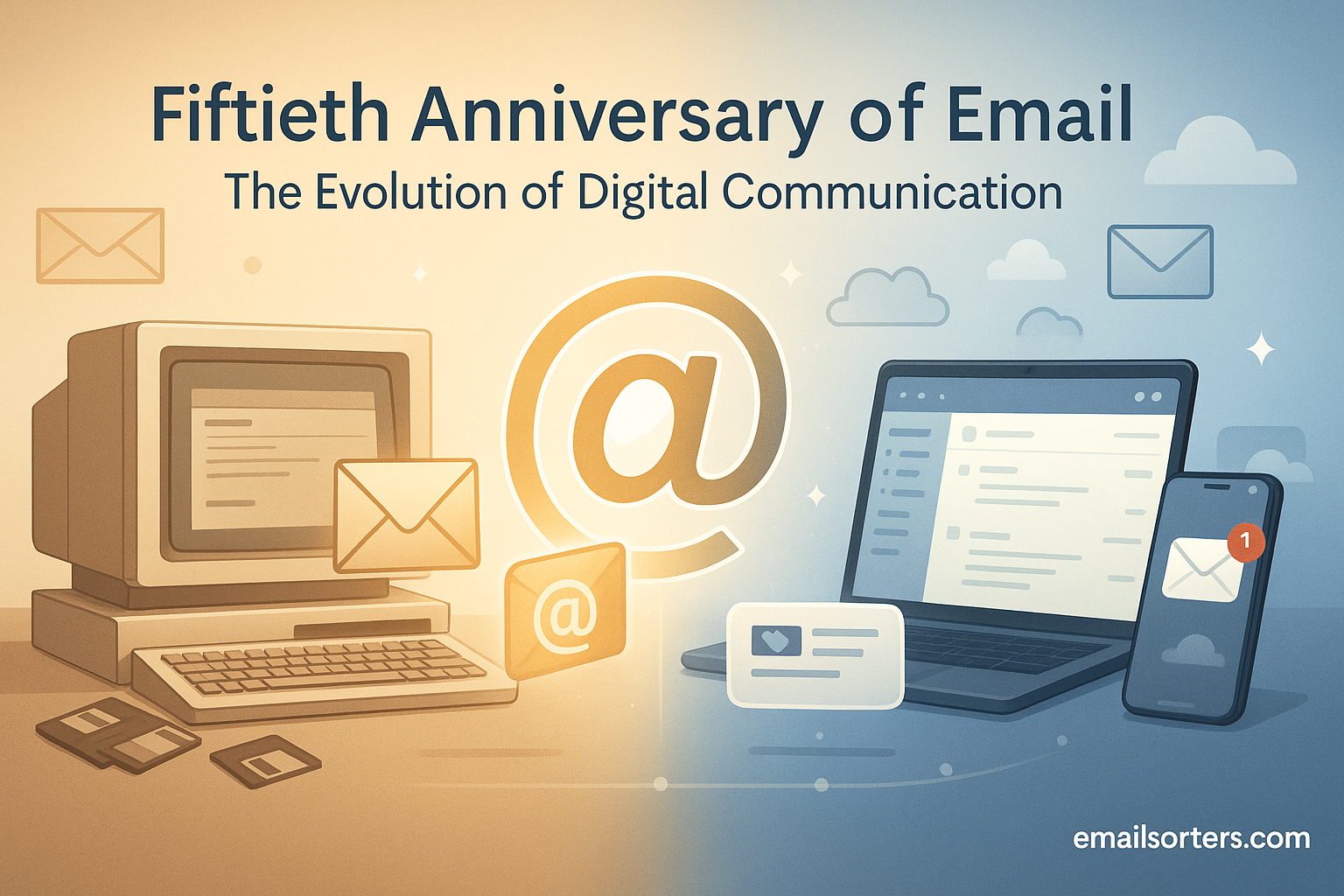
The fiftieth anniversary of email marks a milestone for the most resilient tool in digital history. Email is the official language of business. It’s the permanent address for our digital lives. It’s the foundation of online identity. Unlike trendy apps that fade away, email has remained the undisputed standard for communication for five decades. This article explores the complete evolution of email, from a simple test message to the AI-powered inbox of tomorrow. We will cover its origins, its cultural impact, and why it remains more critical than ever.
What Started the Email Revolution 50 Years Ago?
The first true email is credited to programmer Ray Tomlinson in 1971. He sent a test message between two computers at BBN Technologies as part of the ARPANET project. This message was the first to use the “@” symbol to separate a user’s name from their host machine, creating the user@host standard we still use today.
The Birth of the “@” Symbol
Before 1971, there were “mailbox” programs. These allowed users to leave messages for others on the same computer. This was like leaving a note on a shared family bulletin board.
Ray Tomlinson’s work was different. He was working on ARPANET, the precursor to the modern internet. He needed a way to send a message from one computer to a different computer across the network. He modified an existing program called SNDMSG.
The problem was addressing. How could the network know who the message was for and where that person was? Tomlinson chose the “@” symbol. It was a logical choice. The symbol meant “at” or “located at.” It was also rarely used in programming, so it wouldn’t conflict with code. This single keystroke created the universal format for email addresses.
What Was in That First Email?
The content of the very first network email is famously forgotten. Tomlinson himself has said it was most likely “QWERTYUIOP” or something similarly trivial. The message itself was not the point. The act of sending it was the breakthrough. It proved that direct, person-to-person communication over a digital network was possible. It laid the groundwork for everything that followed.
How Did Email Evolve from ARPANET to Your Pocket?
Email transformed from a niche tool for academics and military researchers into a global communication system in pockets everywhere. This journey involved key stages: the first desktop clients, the rise of commercial “walled gardens,” the explosion of free webmail, and finally, the dominance of mobile access.
What Were the First Major Email Programs?
In the 1980s, email moved from massive mainframes to personal computers. Early programs like Eudora, Elm, and Pine brought email to universities and tech-savvy users. These “email clients” were software applications you installed on your computer. They downloaded your mail from a server, allowing you to read and write messages offline. This was a major step in making email a personal productivity tool, not just a network experiment.
How Did “You’ve Got Mail!” Change Public Perception?
For most people, the internet arrived with the sound of a dial-up modem. Services like America Online (AOL) and CompuServe dominated the 1990s. They were “walled gardens,” providing curated content, chat rooms, and email. The triumphant “You’ve Got Mail!” soundbite made email a mainstream, cultural event. It associated email with excitement and connection. While these services were proprietary, they introduced tens of millions of people to the concept of an inbox and an online identity.
Why Was Hotmail So Disruptive in 1996?
Hotmail (originally HoTMaiL) changed the game completely. It launched in 1996 as one of the world’s first “webmail” services. The concept was radical. Your email wasn’t tied to your Internet Service Provider (like AOL) or your work computer (like Eudora). It was free. You could access it from any computer in the world with a web browser. This uncoupled email from a single device, making it truly portable for the first time.
How Did Gmail Change the Game in 2004?
By the early 2000s, free webmail was common, but it was limited. Inboxes had tiny storage limits, forcing users to constantly delete messages. Then, on April 1, 2004, Google launched Gmail. Many thought it was an April Fool’s joke.
Gmail offered one gigabyte of storage. This was 1,000 times more than many competitors. This “storage wars” launch reset industry expectations. Gmail also introduced a powerful search-based interface. Instead of forcing users to file messages into complex folder structures, Gmail encouraged users to archive everything and use search to find it later. It also grouped messages into “conversations” or threads, making it easier to follow a discussion.
Is Email Still Relevant in the Age of Slack and Teams?
Yes, absolutely. While team chat apps handle internal, real-time conversation, email remains the undisputed standard for official, external, and asynchronous communication. It is the primary tool for business, marketing, and establishing your personal digital identity.
Email vs. Instant Messaging: What’s the Key Difference?
Team chat apps (like Slack or Microsoft Teams) are built for synchronous communication. They are a “tap on the shoulder.” They are great for quick questions, real-time collaboration, and team culture.
Email is built for asynchronous communication. It does not demand an immediate response. It allows for thoughtful, detailed, and formal messages. You send an email on your schedule, and the recipient reads it on theirs. This respect for focus is why it endures in professional settings.
Here is a simple breakdown:
| Feature | Team Chat (e.g., Slack) | |
| Pace | Synchronous (Real-time) | Asynchronous (Send & wait) |
| Format | Informal, fast, conversational | Formal or informal, structured |
| Best For | Quick questions, team updates | Formal documents, external clients |
| Ownership | Closed system (company-owned) | Open, universal protocol |
| Record | Searchable, but ephemeral | Permanent, official record |
Why Do Businesses Still Run on Email?
Businesses rely on email for several critical reasons:
- Universal Standard: Everyone has an email address. You do not need to check if your client is on the same Slack workspace.
- Official Record: Emails are a legal, time-stamped record of communication. They are used for contracts, proposals, formal approvals, and HR documentation.
- Ownership and Control: A business can own its email domain. This builds brand authority and ensures they control their own communication platform.
- Marketing Channel: Email marketing remains the highest ROI (Return on Investment) channel for many businesses. It is a direct line to customers who have opted-in to hear from the brand.
What is Email’s Role in Digital Identity?
Think about your online life. How do you sign up for a new service? How do you reset your password for your bank? How do you receive a receipt for an online purchase? It all requires an email address. Your email is your digital passport. It is the central key that unlocks and verifies your identity across the entire internet. This is a function that no social media or chat app can replace.
What Key Innovations Have Shaped Modern Email?
Modern email feels simple, but it runs on a complex stack of technologies developed over decades. Key innovations include standardized protocols for sending and receiving, filtering systems to fight spam, and security measures to protect users.
What are SMTP, POP3, and IMAP?
These acronyms are the engine of the email system. They are the protocols, or rules, that let different email programs talk to each other.
- SMTP (Simple Mail Transfer Protocol): This is the “postman” of the internet. When you hit “send” on an email, SMTP is the protocol your email client uses to send the message to the recipient’s email server.
- POP3 (Post Office Protocol 3): This is an older protocol for receiving mail. It downloads your email from the server to your device and then (usually) deletes it from the server. It is like the postman delivering a letter to your house. Once you have it, the post office does not keep a copy.
- IMAP (Internet Message Access Protocol): This is the modern standard for receiving mail. IMAP syncs your email client with the server. Your emails live on the server, and you access them from any device (your phone, your laptop, a web browser). When you read an email on your phone, it shows as “read” on your laptop. This is the protocol most of us use today.
When Did Spam Become a Problem?
The first major “spam” message was sent in 1978 to ARPANET users. But spam truly exploded in the 1990s as the internet became commercial. The term “spam” is famously taken from a Monty Python sketch.
The most infamous early example was a 1994 message from two lawyers, Canter and Siegel, advertising their “Green Card Lottery” services. They sent it to thousands of Usenet newsgroups. The internet community was outraged. This event marked the beginning of the spam wars. Today, fighting spam is a massive industry. Modern filters use complex algorithms and AI to analyze billions of messages, protecting inboxes from floods of unwanted mail.
How Does Email Encryption Work?
Email was not originally built to be secure. By default, messages are sent as plain text, which can be intercepted. To fix this, several encryption methods were developed.
- PGP (Pretty Good Privacy): Created in 1991, PGP is a “public-key” cryptography system. It allows users to encrypt messages so only the intended recipient (with their private key) can read them.
- S/MIME (Secure/Multipurpose Internet Mail Extensions): This is a similar standard often built into corporate email clients.
- TLS (Transport Layer Security): This is the most common form of security today. TLS encrypts the connection between your email client and the email server. This prevents eavesdropping while the email is in transit. You see it as the “lock” icon in your browser.
How Has Email Impacted Culture and Society?
Email did more than just speed up the post office. It fundamentally rewired how we work, communicate, and even think. It flattened hierarchies, created new forms of etiquette, and introduced new challenges like information overload.
The “CC” and “BCC” Effect: How Email Changed Office Politics
Before email, communicating with a large group was difficult. You had to send physical memos. Email made group communication effortless. The “CC” (Carbon Copy) and “BCC” (Blind Carbon Copy) fields created new social and political dynamics.
Adding a manager to a “CC” field can be a power move. Being left off a “CC” list can feel like an exclusion. The “Reply All” button has become a famous source of corporate embarrassment. Email broke down traditional top-down communication, allowing anyone to message anyone else. This flattened hierarchies but also created a new layer of digital politics.
The Rise of Email Marketing: From Nuisance to Necessity
As inboxes swelled, businesses saw an opportunity. Email marketing grew from simple text newsletters to a sophisticated industry. Today, it involves segmentation, personalization, automation, and A/B testing.
A good marketing email feels personal and relevant. A bad one feels like spam. This balance is the core of modern email marketing. It remains one of the most effective ways for a brand to build a direct relationship with its customers.
What is “Inbox Zero”?
As email became the default for all communication, a new problem arose: information overload. The stress of an overflowing inbox, full of unread messages and unanswered requests, became a modern affliction.
In response, productivity expert Merlin Mann introduced the concept of “Inbox Zero” in 2007. It is not about having zero emails. It is a philosophy for processing messages. The goal is to spend less time in your inbox by making quick decisions: Delete, Delegate, Respond, Defer, or Do. This movement shows how a simple tool can create complex productivity challenges.
The Dark Side: Phishing, Scams, and Data Breaches
Email’s greatest strength—its open, universal nature—is also its greatest weakness. It is the number one vector for cyberattacks.
- Phishing: These are fraudulent emails disguised to look like they are from a trusted source (like your bank or HR department). They are designed to trick you into revealing sensitive information, like passwords or credit card numbers.
- Scams: From the “Nigerian Prince” scam to modern invoice fraud, con artists use email to target millions.
- Malware: Malicious software is often delivered as an email attachment (e.g., a “resume.zip” or “invoice.pdf”).
What Does the Future of Email Look Like?
The future of email is interactive, intelligent, and more integrated. Email is not dying; it is evolving into a more powerful platform.
What is AMP for Email?
AMP for Email is a new technology that allows for interactive content inside an email. Instead of clicking a link to visit a website, you can:
- RSVP to an event.
- Browse a product catalog.
- Fill out a survey.
- Leave a comment.
All of this happens directly within the message. This turns email from a static page into a dynamic, app-like experience.
How is AI Changing Email?
Artificial intelligence is already in your inbox.
- Smart Replies: Gmail and Outlook suggest short, context-aware replies.
- Priority Inbox: AI algorithms sort your mail, filtering important messages from promotions and spam.
- AI Drafting: AI tools can now help you compose, summarize, or rewrite your emails, adjusting the tone for your audience.
In the future, AI will act as a true digital assistant, summarizing long email threads, scheduling meetings automatically, and protecting you from sophisticated phishing attacks.
What is BIMI (Brand Indicators for Message Identification)?
Security continues to evolve. BIMI is a new standard that attaches a brand’s official logo to its authenticated emails. This allows a user to visually verify that an email is legitimate. It is a simple, powerful way to build trust and fight phishing. When you see the official logo of your bank in your inbox, you can be more confident that the message is real.
Practical Email Management for the Next 50 Years
Email’s longevity means we all need good habits to manage it. A well-organized email system saves time and reduces stress. Here are some foundational tips for managing your digital identity.
How Do I Create a New Email Account?
Creating a new email account is your first step. You will choose a provider (like Gmail, Outlook, or a private host) and select a username. This username, paired with the provider’s domain, becomes your full email address.
What’s the Best Way to Organize Email?
The best method is the one you stick with. Some people prefer a detailed system of configured email folders for different projects or clients. Others use the “Archive” button and rely on search. Most modern providers, like Gmail, use “Labels,” which are more flexible than folders, as a single email can have multiple labels.
Should I Have Different Email Addresses for Different Purposes?
Yes. This is a smart way to manage your digital life. Having different email addresses is a common and effective strategy. Consider having at least three:
- Personal: For friends and family.
- Professional: For work, clients, and your public-facing identity.
- Spam/Subscriptions: An address you use to sign up for newsletters, store loyalty cards, and new services. This keeps your primary inboxes clean.
How Can I Manage Email for My Family or Children?
Setting up email for your family requires special consideration. You may want a central family email account for household bills or shared calendars. When setting up email for children, it is critical to use providers that offer strong parental controls to ensure their safety. A student email account, often provided by a school, comes with its own set of features and filters.
How Do I Manage Email on My Phone?
Mobile access is essential. Learning how to set up email on your iPhone or Android device involves adding your account credentials to the built-in mail app or downloading your provider’s dedicated app. This allows you to stay connected from anywhere.
What Happens to Inactive Email Accounts?
Be careful with old accounts. Providers have policies about inactive email accounts. After a certain period of inactivity (usually 6-24 months), a provider may delete your account and all its data. This can be a security risk, as a scammer could potentially register your old, abandoned address.
A Note on Email Etiquette
- Drafts: Use your email drafts folder. If you are writing an angry or sensitive email, save it as a draft and re-read it an hour later.
- Logout: Always be aware of security. If you are on a public computer, make sure your account is set to automatically log out.
- Multiple Accounts: It is perfectly normal to manage multiple accounts. Most email clients allow you to add all your accounts into one unified inbox.
The Unkillable Communication Tool
As we celebrate the fiftieth anniversary of email, one thing is clear. Email is not going away. It has survived the rise of instant messaging, social media, and team chat. It has adapted and evolved.
Email remains the internet’s most critical protocol. It is the system of record, the tool for formal business, the key to our digital identity, and the foundation for marketing and commerce. It is the one digital tool that has been with us from the beginning, and it will be with us for the next 50 years. For more on the technical origins, you can read the detailed history of email and its various protocols.