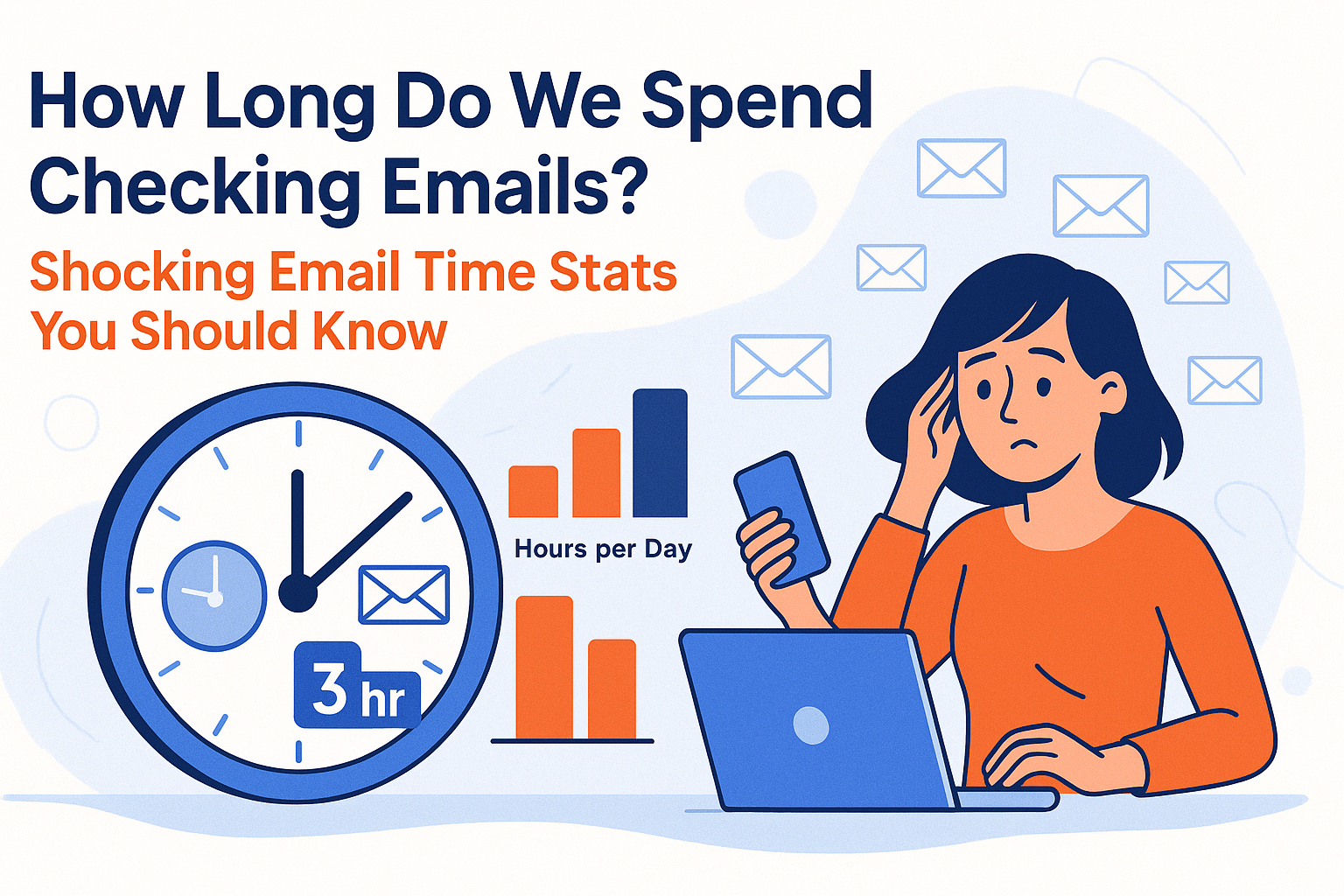
Checking emails, let’s be honest, how many times have you done that today? If you’re like most people, the answer is probably “too many.” What started as a quick task has turned into something that eats up hours without us even noticing. But just how long do we spend checking emails each day or week? The latest email time stats are surprising.
Email has become a lifeline for work updates, school notices, shopping receipts, and newsletters we never read. Yet, we rarely stop to think about how much time it takes from our lives. When you look at these email time stats, it’s clear we’re spending far more time than we realize.
Every second spent refreshing your inbox is time lost forever, time you could use to build your dreams, make memories, or simply take a break. This article reveals how long we spend checking emails, what it does to our focus and peace of mind, and easy ways to take back our time.
How Long Do We Spend Checking Emails?
On average, people spend about 3 to 5 hours each day checking emails. Studies show that office workers check their inbox every 6 to 10 minutes, adding up to over 15 hours each week. These email time stats include reading, replying, sorting, and deleting messages.
When you think about how long we spend checking emails over a year, it adds up to hundreds of hours lost. That’s time that could be spent working on goals, enjoying family, or just relaxing away from screens.
Now, that’s just the average. Some people, especially those in executive roles, report spending up to 4 to 5 hours daily dealing with emails. This isn’t just about sending a few quick messages. It’s reading through chains, deciphering unclear requests, searching for attachments, and crafting thoughtful responses that often go unread or unanswered.
When we talk globally, email usage is exploding. As of 2025, over 4.5 billion people are using email, sending more than 347 billion emails daily. With remote work becoming the new norm, email remains a top communication tool, often replacing casual in-person conversations or quick desk check-ins.
The frequency is alarming, too. On average, workers check their email 15 times per day, that’s once every 37 minutes. And in a hyper-alert digital environment, that number can spike to once every 10 minutes. It’s a clear sign: our inboxes are controlling us more than we realize.
And if you thought personal email would be a safe zone, think again. The typical user checks both personal and work email multiple times a day, often first thing in the morning and last thing before bed. It’s become a subconscious habit, like scrolling through social media or grabbing your phone just because it buzzed.
Email Habits by Profession
Not all professions engage with email in the same way. If you’re a corporate employee, especially in management or client-facing roles, email probably consumes a large portion of your day. Think about HR managers, marketers, project coordinators, or sales professionals; most of their job revolves around constant communication, and email is at the center of it.
A recent Adobe Email Usage Study revealed that white-collar workers spend an average of 3.1 hours a day on work email, with an additional 2.5 hours on personal email. That’s over 5 hours daily! Imagine what else could be accomplished in that timeframe.
Freelancers, on the other hand, often juggle multiple clients and projects. Their inbox becomes a mini-CRM system, filled with proposals, contracts, payment confirmations, and revision requests. While they may not face internal email threads like corporate workers, they often overcompensate with increased client communication, averaging 2-3 hours daily on emails.
Healthcare professionals and field service workers may use email less frequently, depending on their role. For instance, nurses or technicians spend little to no time on email, while administrators or health consultants might log hours similar to their corporate counterparts.
Tech professionals also exhibit unique patterns. Developers and engineers prefer tools like Slack or Jira for internal discussions, but still spend up to 90 minutes a day checking emails for updates, bug reports, or client queries.
Email Usage by Age Group
Different generations have different digital habits, and email is no exception. Let’s start with the Gen Z crowd—those born after 1997. Raised in the age of instant messaging and social media, Gen Z views email more as a formal communication tool. They prefer DMs, texts, or collaboration apps. Yet when it comes to job applications or formal documentation, they still engage with email—just not as frequently. On average, Gen Z spends about 1.5 to 2 hours daily on email.
Millennials, on the other hand, are email-savvy and often digitally overwhelmed. They’re the first generation to grow up with email as a norm, and now in their peak working years, they spend over 3 hours daily on emails—especially in remote or hybrid work environments.
Gen X and Boomers are the email veterans. Gen Xers (born between 1965-1980) spend the most time in their inboxes, often exceeding 4 hours daily. They were the early adopters of email in the workplace and are more likely to rely on it for all kinds of tasks, from status updates to holiday planning.
Boomers, surprisingly, aren’t far behind. Although many are retiring or working part-time, those who are still active in the workforce use email religiously, often checking it first thing in the morning and multiple times throughout the day.
Interestingly, studies show that regardless of age, nearly 85% of people check their emails before 9 AM, and over 70% check them right before going to bed. That’s a clear sign that email isn’t just a tool, it’s a lifestyle.
The Real Cost of Email Overload
Ever feel mentally drained after spending a day replying to emails? That’s no coincidence. Email overload doesn’t just eat into your work hours, it takes a serious toll on your mental health and productivity. We’ve become conditioned to treat our inboxes like an emergency room: everything feels urgent, and everything demands attention now. But that mindset is draining us.
Studies show that frequent email checking can lead to cognitive fatigue, decision paralysis, and even burnout. Why? Because every time we get interrupted by a new message, it breaks our concentration. The average person needs about 23 minutes to refocus after being interrupted. Multiply that by a dozen or more daily interruptions, and it’s no wonder you’re exhausted.
Productivity experts warn that the constant flow of emails gives us the illusion of busyness. Sure, replying to emails feels productive—but it rarely equates to real progress. You’re being reactive, not proactive. You’re working in your inbox instead of working on your goals.
Plus, there’s a ripple effect. Email overload often results in missed deadlines, forgotten tasks, and fractured communication. People spend hours scrolling through threads just to find one attachment or message. This inefficiency can cost businesses thousands of dollars per employee annually.
But perhaps most damaging is the psychological impact. The pressure to respond quickly leads to anxiety. The dread of an overflowing inbox can even trigger avoidance, which makes the problem worse. It’s a vicious cycle—and the first step to breaking it is awareness.
Multitasking and Email Distractions
Here’s a hard truth: multitasking is a myth. The human brain isn’t built to focus on multiple tasks at once. Instead, it switches rapidly between them, and every switch comes at a cost. When you’re working on a report and decide to check an incoming email “just for a second,” you’ve already lost focus.
According to research, multitasking with email can reduce your IQ temporarily by up to 10 points, equivalent to missing a night’s sleep. And that’s not just a fun fact; it has real implications for your job performance, creativity, and well-being.
Email is one of the biggest culprits of distraction. It’s always open in the background, with notifications pinging you like a needy toddler. Every ding feels important, so you stop what you’re doing to check. But those interruptions kill momentum. The more you check your email, the more scattered your thoughts become.
And let’s not forget about the emotional distractions. A stressful or vague email can hijack your mood for hours. Suddenly, you’re overthinking a single sentence, rereading it ten times, or even drafting three different versions of a reply. Meanwhile, your to-do list is untouched.
Want to reclaim your focus? Start by turning off email notifications. Set specific times to check your inbox. And treat your inbox like a task list, not a chat room. Your brain will thank you.
Inbox Zero: Myth or Miracle?
Ah, the fabled Inbox Zero. For some, it’s the holy grail of productivity. For others, it’s a never-ending rabbit hole. But what is it really?
Inbox Zero is a philosophy coined by productivity expert Merlin Mann. The idea is simple: maintain an inbox with zero unread or pending emails. Every message should be either deleted, delegated, responded to, deferred, or done, immediately.
Sounds magical, right? And it can be. A clean inbox can give you a sense of control, reduce stress, and improve focus. It signals that you’re on top of things, that nothing’s slipping through the cracks.
But there’s a dark side. In the pursuit of Inbox Zero, many people fall into the trap of email obsession. They spend hours every day clearing their inbox instead of doing meaningful work. And the moment new emails come in? The cycle starts again. It’s like playing whack-a-mole with your digital messages.
The key is balance. Inbox Zero should be a tool, not a goal in itself. Use it to build better habits: filter your messages, categorize your priorities, and schedule times for deeper responses. But don’t let it become your identity. Remember, the goal isn’t just a clean inbox—it’s a clear mind.
Email Checking Frequency: How Often Is Too Often?
How often do you check your email? For most people, it’s far more than necessary. The average professional checks their email every 6 to 12 minutes, about 80 times a day. Some keep their inbox open all day, glancing at it like a clock. This habit has become automatic, similar to scrolling social media or opening the fridge.
This frequent checking harms productivity. Each glance may only take seconds, but the overall effect is significant. Constant interruptions break your focus, increase stress, and make you more reactive. Instead of controlling your schedule, you respond to others’ demands.
A better method is to batch email tasks. Set two to three specific times each day to check and reply to emails. This improves efficiency and helps others understand you won’t reply instantly. You create boundaries and protect yourself from burnout.
For urgent communication, use chat tools like Slack or Microsoft Teams. Email was designed as a deliberate tool, not instant messaging. Treat it accordingly.
Work vs. Personal Email Time
Now here’s a tricky one. In today’s blurred world of work-from-home, hybrid jobs, and side hustles, the line between personal and professional email has all but disappeared.
Most people don’t just have one inbox; they have three or four. A work email, a personal Gmail, maybe a newsletter email, and a junk account for online shopping. And guess what? They check all of them, every day.
Work email typically dominates during business hours. But a personal email doesn’t just wait politely. Promotions, receipts, family updates, they flood in throughout the day. And because smartphones make both inboxes accessible in one swipe, we often toggle between them without thinking.
Studies show that the average person spends more than 90 minutes daily checking personal emails, even while at work. That’s time taken away from deep work and actual productivity.
The solution isn’t to eliminate one or the other; it’s to compartmentalize. Turn off non-work email notifications during work hours. Set a 15-minute window in the evening to handle personal emails. Use different apps or inboxes if needed. And most importantly, don’t let your inbox dictate your day. You decide when to engage, and when to disconnect.
Tools and Techniques to Reduce Email Time
To reduce email time and boost productivity, use proven email management tools and effective strategies. Time blocking is essential. Set specific times, morning, after lunch, and before the day ends, to check and respond to emails. Outside these periods, close your inbox and mute notifications to focus fully.
Email batching saves time by grouping similar tasks together, like replying to client messages or reviewing reports all at once. This method reduces distractions and speeds up your workflow.
Use email templates or canned responses for frequent replies, such as meeting confirmations or follow-ups. Most email platforms like Gmail and Outlook support quick setup of templates, cutting down repetitive typing.
Leverage email scheduling tools to compose emails when convenient and schedule them to send during regular work hours. This avoids interruptions and prevents setting expectations for 24/7 availability.
By combining these tools and techniques, you can significantly reduce email time, regain control over your inbox, and improve your daily productivity.
Automation and Filters to Manage Your Inbox
Using email automation tools and filters is key to cutting down the time spent managing your inbox. Set up email filters in platforms like Gmail or Outlook to automatically sort incoming messages by sender, subject, or keywords. For example, move newsletters to a “Read Later” folder or invoices to “Finance,” keeping your main inbox clutter-free.
Leverage automation services like Zapier, Mailparser, or Clean Email to create workflows that handle tasks automatically, such as saving attachments, flagging important emails, or unsubscribing from unwanted lists.
To reduce spam and junk mail, use bulk unsubscribe tools like Unroll.Me or Leave Me Alone. The fewer irrelevant emails you get, the less time you spend deleting them.
Don’t forget auto-responders. Set up automatic replies during vacations or focused work periods to let senders know when you’ll reply, helping you set clear boundaries and reduce pressure to respond immediately.
Prioritizing Emails Efficiently
Here’s where most people struggle: not every email needs a reply. Not every message needs a deep read. Learning to prioritize emails is one of the most valuable skills you can develop in today’s inbox-obsessed world.
Start by categorizing your emails as:
- Urgent and important (needs action ASAP),
- Important but not urgent (can be scheduled),
- Not important but urgent (delegate or reply briefly),
- Neither important nor urgent (delete or archive).
This is basically the Eisenhower Matrix in action. You can create labels or folders based on these categories and filter incoming emails accordingly.
Most email clients also allow stars, flags, or pins. Use these features to highlight key messages that need a follow-up. But don’t go overboard, if everything is marked as important, nothing really is.
Another effective trick? Subject line scanning. In just a few seconds, you can usually tell if an email deserves your attention. Look for emails from your boss, major clients, or anything tagged with high-priority keywords.
Also, don’t hesitate to be aggressive. If an email doesn’t require action or reference, get it out of your inbox. Trust the search function—it’s better to retrieve something later than to sift through hundreds of messages daily.
Case Studies: How Companies Cut Down Email Time
Many companies have successfully reduced email overload and improved productivity with smart email management strategies.
Google encourages employees to use tools like Google Chat and Google Meet instead of lengthy email threads. They train teams to use clear subject lines and limit CCs, cutting down unnecessary back-and-forth emails.
Basecamp has a company-wide policy discouraging internal emails altogether. They use their project management platform for communication, which leads to faster collaboration and fewer distractions.
Slack Technologies, creator of the Slack app, has nearly eliminated internal email by moving all internal communication to Slack. This change drastically cuts email checking time, especially for cross-functional teams.
Even smaller startups adopt methods like “email-free days” or fixed email hours. Some use asynchronous video tools like Loom to replace long email explanations.
These companies are not anti-email , they’re smart about email use. By setting clear boundaries, adopting better tools, and training their teams, they’ve reclaimed thousands of productive hours. You can do the same.
Email Alternatives That Save Time
Email isn’t the only way to communicate, and often it’s not the best. Using the right email alternatives can dramatically reduce your email time and boost team collaboration.
Chat platforms like Slack, Microsoft Teams, and Discord handle real-time conversations, quick questions, and updates. They cut down “just following up” emails and messy reply-all chains.
For task tracking and teamwork, project management tools such as Asana, Trello, and ClickUp let teams assign tasks, monitor progress, and comment, all without emails. This reduces unnecessary back-and-forth.
Project documentation tools like Notion and Confluence keep knowledge centralized. Instead of emailing for files or info, everyone finds what they need in one place.
Even voice and video tools like Loom or Zoom save time. A short screen-recorded explanation often replaces long email threads.
The key is to match the right tool to the task. Use email for formal communication and external contacts. Use chats and project tools for quick collaboration. The less you depend on email, the more time you’ll have to get real work done.
Conclusion
Most people spend too much time checking emails. What began as a helpful tool has become a major distraction during work hours, mornings, evenings, and even weekends. Constantly looking at your inbox can feel like a full-time job.
However, it is possible to reduce email time and regain control over your productivity and mental space. Applying email management strategies such as batching emails, using automation, setting smart filters, and adopting better communication tools can cut down the time spent on emails significantly.
The problem is not email itself, but how it is used. With the right information and practical methods, it’s possible to reduce email overload and improve focus. Simple steps like turning off notifications and scheduling specific times to check email can create more mental clarity.
Taking control of your inbox helps you save time, increase focus, and reduce stress.
FAQs
1. How much time do we waste on email each day?
The average person spends over 2.5 to 3 hours daily checking emails, often in fragmented bursts that interrupt productivity. That adds up to more than 650 hours a year.
2. What’s the best way to manage email overload?
Start by batching email time into 2-3 blocks per day. Use filters, unsubscribe from unnecessary lists, and prioritize messages based on urgency. Consider tools like Slack for internal communication to reduce dependency on email.
3. Should I check email first thing in the morning?
It’s tempting, but not ideal. Diving into your inbox first thing often derails your priorities. Instead, focus on your top task for the day and tackle email during a scheduled time block.
4. Is Inbox Zero worth it?
Inbox Zero can be a helpful mindset, but don’t let it become an obsession. Focus on processing emails efficiently rather than keeping your inbox perfectly clean.
5. How do successful people manage their emails?
Many successful professionals check emails only twice a day, use templates, and rely on tools like virtual assistants, filters, and collaborative platforms to reduce time spent checking emails.