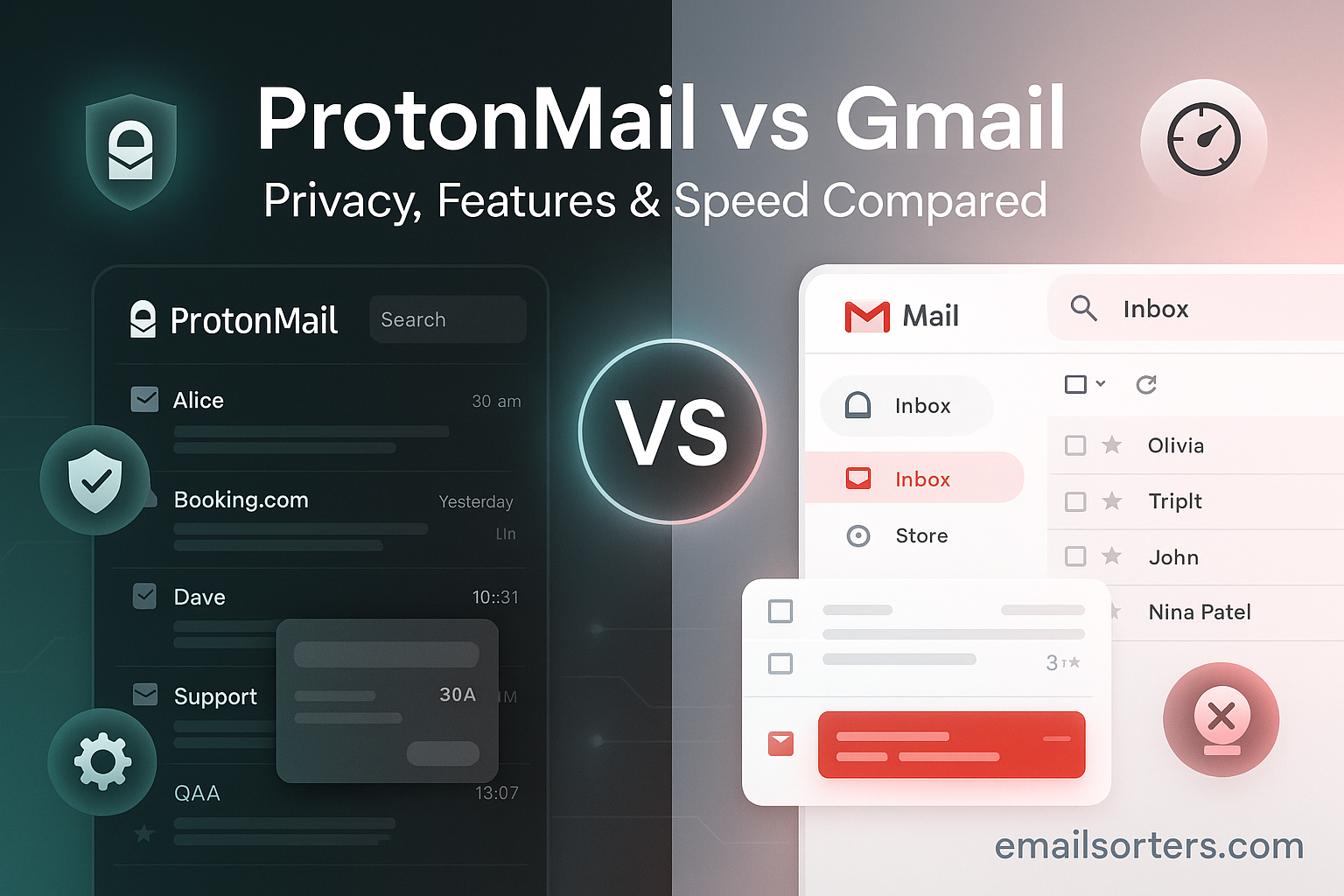
The choice between ProtonMail vs Gmail is one of the most significant decisions a user can make about their digital identity. It is a choice that goes beyond simple features, representing a fundamental decision between two opposing philosophies: unparalleled privacy versus unmatched convenience. ProtonMail offers a secure, encrypted ecosystem designed to protect user data at all costs, while Gmail provides a powerful, feature-rich experience deeply integrated into the Google ecosystem.
This 2025 guide provides an in-depth comparison of these two email giants. We will explore their core philosophies, conduct a deep dive into their vastly different privacy and security models, and compare their feature sets, performance, and overall user experience. This analysis will empower you to choose the service that best aligns with your personal needs and values.
The Core Philosophy: A Fundamental Divide
To understand these two services, one must first understand the missions of the companies that built them. They are fundamentally different, and this difference informs every aspect of their products.
ProtonMail’s Mission: Privacy by Default
ProtonMail was founded by scientists at CERN who believed in a more private and secure internet. Its core mission is to protect user data and civil liberties. The entire service is built around the principle of privacy by default. It is based in a country with some of the world’s strongest privacy laws. Its business model is straightforward: users pay a subscription for enhanced privacy features and more storage. The company’s very structure is designed so that it cannot access the content of user emails.
Gmail’s Mission: Universal Access to Information
Google is one of the largest data companies in the world. Its mission is to organize the world’s information and make it universally accessible and useful. Gmail is a key part of this mission. Its business model is to provide a powerful, feature-rich service for free to billions of users. In exchange, it leverages user data to provide intelligent, personalized features and to power its massive advertising business. For Gmail, convenience, features, and accessibility are the top priorities.
The Deciding Factor: A Deep Dive into Privacy and Security
This is the area where the two services are most different. Their approaches to encryption and data handling are worlds apart.
End-to-End Encryption (E2EE) Explained
ProtonMail’s main security feature is end-to-end encryption (E2EE). Think of E2EE like sending a package in a locked box where only you have one key and only the recipient has the other. While the package is in transit, no one—not the postal service, not a government, and not even ProtonMail—can open the box and see its contents. This is automatically applied to all messages sent between ProtonMail users.
Zero-Access Encryption: Protecting Stored Mail
ProtonMail also uses zero-access encryption for all emails stored on its servers. This means that even the emails you receive from outside services (like a message from a Gmail user) are encrypted on their servers in a way that ProtonMail itself cannot decipher. This ensures that even if their servers were breached, the content of your emails would remain unreadable.
How Gmail’s Encryption Works (TLS)
Gmail’s security is also robust, but it uses a different model. It uses Transport Layer Security (TLS), which is the standard for encryption-in-transit. Think of TLS as a secure, armored truck. While your email is traveling from your computer to Google’s servers, it is protected inside this truck. However, once the email arrives at Google’s data center, Google unlocks the truck to process the message. This allows them to scan it for spam and viruses, and to power features like Smart Reply and add it to your Google Calendar. The content is accessible to Google.
The Practical Implications of E2EE
ProtonMail’s superior privacy model comes with practical trade-offs. Because the body of your emails is encrypted, ProtonMail cannot perform a deep, server-side search of your email content. Search is processed client-side, which can be slower. Subject lines are not end-to-end encrypted, so they should not contain sensitive information. Most critically, if you forget your password and lose your recovery methods, ProtonMail cannot reset your account for you, as they have no way to decrypt your data.
Feature Set and Ecosystem Comparison
Beyond privacy, the day-to-day usability of an email service is defined by its features and how it integrates with other tools.
Gmail’s AI-Powered, Integrated Ecosystem
This is Gmail’s greatest strength. It is packed with a suite of intelligent features that are unmatched in the industry.
- AI Assistance: Features like Smart Compose, which suggests entire sentences as you type, and Smart Reply, which offers one-click responses, dramatically speed up communication.
- Organization: The tabbed inbox automatically categorizes mail into Primary, Social, and Promotions, keeping your main inbox clean.
- Ecosystem Integration: Gmail is the core of the Google Workspace. It is seamlessly integrated with Google Drive, Docs, Sheets, and Calendar. You can save attachments directly to Drive, create calendar events from an email, and collaborate on documents without ever leaving your inbox.
Proton’s Security-Focused Ecosystem
Proton offers its own integrated ecosystem, with every component built around the same privacy-first philosophy.
- Proton Mail: The secure, end-to-end encrypted email service.
- Proton Calendar: An encrypted calendar where the details of your events are kept private.
- Proton Drive: An end-to-end encrypted cloud storage service, a direct alternative to Google Drive.
- Proton VPN: A popular virtual private network service that encrypts your internet traffic. For users who are willing to pay a subscription, the Proton ecosystem offers a complete, private alternative to the Google suite.
The Free Plan Showdown: Limitations vs. Generosity
The free offerings of the two services are very different.
- ProtonMail’s Free Plan: This is designed as a trial or for light use. It comes with significant limitations, including only 1 GB of storage and a cap of 150 messages per day.
- Gmail’s Free Plan: This is a full-featured, powerful service. It offers a generous 15 GB of storage (pooled with Drive and Photos) and a very high daily sending limit, making it suitable for even heavy personal users.
Performance, Speed, and User Experience
The day-to-day feel of an email client is a critical factor. Both services offer a polished and modern experience, with subtle differences in performance.
The Gmail Experience: Speed and Familiarity
Gmail’s web and mobile applications are incredibly fast and responsive. Google’s massive global server infrastructure ensures that emails are sent, received, and searched almost instantaneously. The interface is familiar to billions of users and, while busy, is generally considered intuitive and powerful.
The ProtonMail Experience: Security and Simplicity
ProtonMail offers a clean, minimalist, and ad-free user interface that many users find calming and easy to navigate. The performance is excellent, though the nature of client-side encryption and decryption can, in some cases, introduce a very slight delay that is almost unnoticeable to the average user but different from Gmail’s instant-on feel.
A Comparative Look at the Email Market
The ProtonMail vs. Gmail debate exists within a larger market of diverse email providers, each with its own strengths.
How Gmail Competes with Mainstream Providers
Gmail’s combination of a massive free storage tier and a deep, AI-powered feature set is what sets it apart from other large-scale providers. Our guide on Ymail vs Gmail provides a direct comparison to another major player. In the professional space, its primary competitor is Microsoft, and our Outlook vs Gmail article explores that rivalry.
The Ecosystem Battle
The modern email decision is often an ecosystem decision. For users embedded in the Apple world, the choice is often between Google’s cross-platform accessibility and Apple’s native integration, a topic covered in our Gmail vs iCloud guide.
Comparing to Other Legacy Providers
Both Gmail and ProtonMail represent modern approaches to email, which stand in contrast to older, more traditional services. A look at an AOL Mail overview or a Yahoo Mail overview provides context on how these long-standing platforms fit into the current landscape.
A Checklist for Choosing Your Email Provider
This checklist summarizes the core differences to help you make a clear decision based on what you value most.
Your Decision-Making Guide
This simple list provides a framework for choosing the service that best fits your personal philosophy and technical needs.
- Choose ProtonMail if: Your absolute number one priority is privacy and security. You believe that no one, including your email provider, should be able to read the content of your emails. You are willing to pay a reasonable subscription fee for these advanced privacy features and want an integrated, encrypted ecosystem (Mail, Calendar, VPN, Drive).
- Choose Gmail if: Your primary goals are convenience, speed, and a powerful, feature-rich experience. You want the best-in-class search capabilities and helpful AI-powered assistance. You are a heavy user of the Google ecosystem (Drive, Docs, Photos) and rely on deep integration. You are comfortable with Google’s data model in exchange for an exceptional free service.
Managing Your Inbox, Regardless of Platform
Whether you prioritize privacy or features, every inbox is susceptible to clutter.
The Universal Challenge of Clutter
Both ProtonMail and Gmail inboxes can become overwhelmed with newsletters, notifications, and other low-priority messages. Keeping this clutter organized is key to a productive email experience.
The Role of Third-Party Organizers
For users who need help managing this digital overload, third-party services can provide powerful automation. Tools from companies like Clean Email, for example, are designed to work with both standard and encrypted email providers to help users bulk-delete, unsubscribe, and organize their messages more efficiently.
Frequently Asked Questions (FAQ)
Here are detailed answers to the most common questions users have when comparing ProtonMail and Gmail.
1. If I use ProtonMail, are all my emails encrypted end-to-end?
No, and this is a critical point to understand. End-to-end encryption (E2EE) only works automatically when you are sending an email to another ProtonMail user. If you send an email to an external address (like a Gmail or Yahoo user), it is sent over a standard encrypted connection (TLS), similar to how Gmail works. However, ProtonMail does offer a feature called “Encrypt for Outside,” which allows you to send a password-protected, end-to-end encrypted message to a non-user. The recipient receives a link to view the secure message in their browser.
2. Can I use ProtonMail with a desktop client like Outlook or Apple Mail?
This is a premium, paid feature. Free ProtonMail users can only access their email through the official web application or the official ProtonMail mobile apps. Paid users can download a special application called the Proton Bridge. This software runs in the background on your computer, encrypting and decrypting your mail as it comes and goes. This allows you to securely connect your ProtonMail account to standard, third-party email clients like Outlook, Thunderbird, or Apple Mail.
3. I forgot my ProtonMail password. Can I recover my account?
This is the most critical security trade-off with ProtonMail. Because of their zero-access encryption, ProtonMail cannot reset your password for you in the traditional sense. You must rely on the recovery methods you set up when you created your account, such as a recovery phrase or a recovery email. If you lose your password AND you lose access to your recovery methods, the encrypted data in your account will be permanently and irretrievably lost. This is a feature, not a bug, as it guarantees that no one, not even Proton, can ever access your data without your permission.
4. Does ProtonMail’s encryption hide my identity or make me anonymous?
No. This is a common misconception. ProtonMail’s encryption is designed to protect the content of your emails. It does not hide your metadata. Information like who sent the email, who received it, the subject line, and your IP address is not end-to-end encrypted. For true anonymity, you would need to use ProtonMail in conjunction with an anonymity network like Tor. ProtonMail supports this and even hosts its own Tor onion site for this purpose.
5. Is Gmail’s “Confidential Mode” a good alternative to ProtonMail?
While Gmail’s Confidential Mode is a useful feature, it is not a true alternative to ProtonMail’s end-to-end encryption. When you send an email in Confidential Mode, you can set an expiration date and prevent the recipient from forwarding or printing the message. However, the email itself is still stored on Google’s servers and is fully accessible to Google. It provides a good layer of control against casual sharing, but it does not offer the same level of cryptographic, zero-access privacy as ProtonMail.