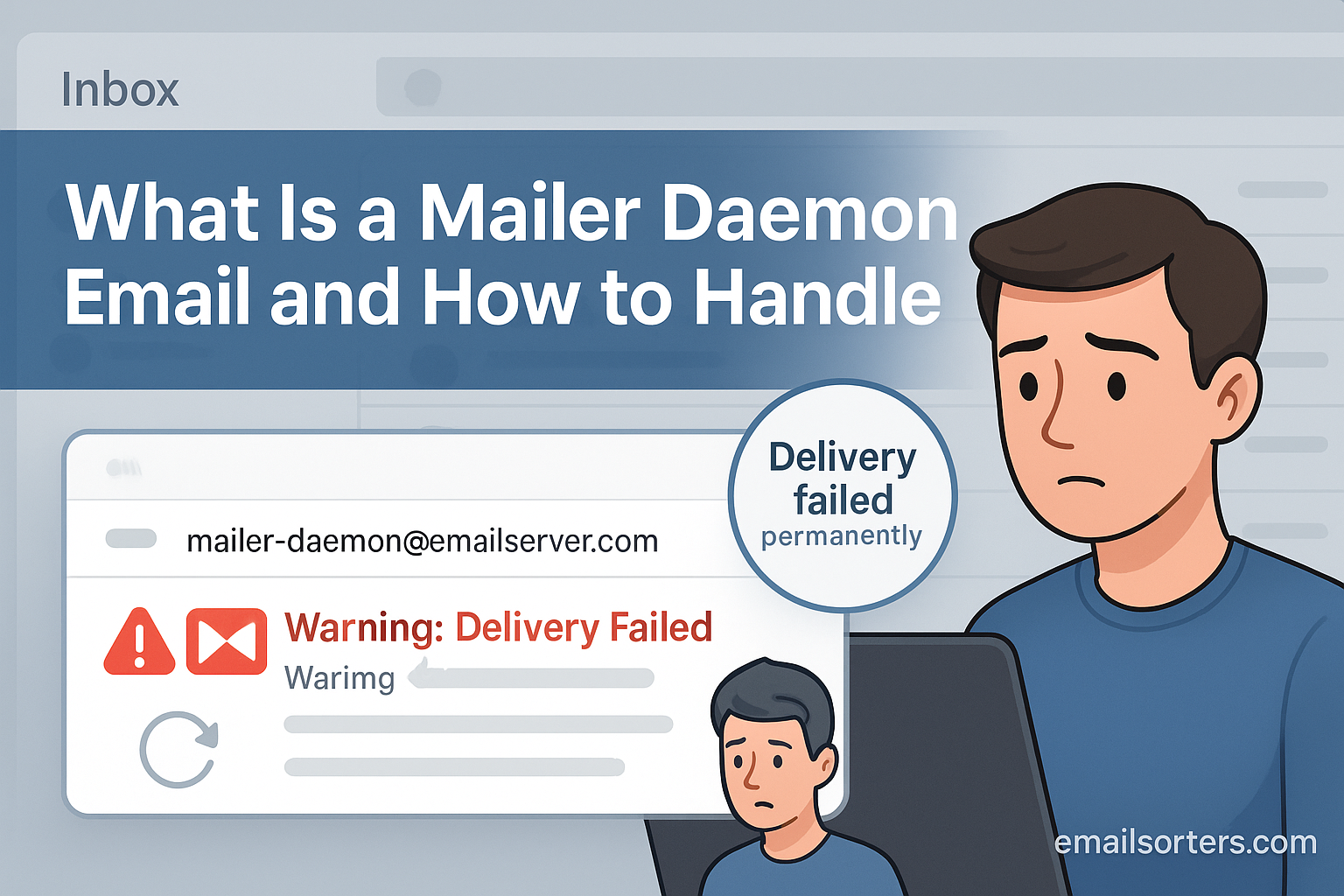
It’s happened to all of us. You hit “Send” on an important email, wait for a reply, and instead… you get a strange, often cryptic message back from something called “Mailer-Daemon.” It usually has a subject line like “Undeliverable Mail,” “Delivery Status Notification (Failure),” or just “Returned mail.”
Your first reaction might be confusion, maybe even a little panic. What is Mailer-Daemon? Did I do something wrong? Is it spam? Is it a virus? And most importantly, did my email actually get delivered?
Relax. You’ve come to the right place. That Mailer-Daemon message isn’t usually something scary. It’s simply an automated notification from the email system telling you there was a problem delivering your message. Think of it as the digital equivalent of getting a “Return to Sender” stamp from the post office.
In this guide, we’ll demystify Mailer-Daemon once and for all. We’ll explain exactly what it is, the top 10 reasons you might receive one, how to actually read those confusing error messages, and what steps you need to take to fix the problem and get your email delivered.
What Does “Mailer-Daemon” Actually Mean?
“Mailer-Daemon” is the generic name for the automated program on an email server responsible for handling messages. When an email you send cannot be delivered, this program automatically sends you a notification, often called a bounce message or Non-Delivery Report (NDR), explaining the failure. It’s essentially the server’s messenger telling you something went wrong.
Think of the email system like a complex postal service. When you send an email, it goes through several “post offices” (servers) on its way to the recipient. Working tirelessly behind the scenes at each stop are automated programs managing the flow of mail. “Mailer-Daemon” is the traditional name given to these background workers. Their job includes routing messages, handling queues, and, crucially, reporting back if a delivery hits a dead end.
The Origin Story: Why the Name “Daemon”? (Understanding Server Processes)
The term “Daemon” might sound a little spooky, but it has a long history in computing, predating even the fiftieth anniversary of email. It originated way back in the 1960s with MIT’s Project MAC. In Unix and Unix-like operating systems (which power most email servers), a daemon is simply a computer program that runs as a background process, rather than being under the direct control of an interactive user.
Think of them as little helper spirits (inspired by Greek mythology’s daemons, which were not necessarily evil) that perform essential system tasks without needing constant supervision. The “Mailer-Daemon” is just the specific daemon program responsible for handling the email system’s background tasks, including sending out those non-delivery notifications when things go awry. It’s a standard, technical term, not an indicator of anything malicious.
Is Mailer-Daemon a Virus, Spam, or Something Malicious? (Spoiler: Usually Not)
This is the most common fear when seeing that unfamiliar sender name. Because the message is automated and often contains technical jargon, people worry it’s a virus, a phishing attempt, or some kind of spam.
In 99% of cases, a legitimate Mailer-Daemon message is NOT malicious. It is simply a factual report from a server telling you your email didn’t go through. It’s a system notification, like getting an error message from your computer.
However, be cautious:
- Never click suspicious links or open unexpected attachments within the quoted body of the bounced email (the part that shows your original message). While the Mailer-Daemon message itself is safe, sophisticated scammers could try to mimic the format to trick you.
- If you receive a Mailer-Daemon bounce for an email you didn’t send, that’s a different issue (we’ll cover that later under “Email Spoofing”). This could indicate a problem, though usually not a virus on your end.
But the standard “Undeliverable Mail” message from Mailer-Daemon? It’s just information.
The Role of Mailer Daemon in the Email Delivery System
The Mailer-Daemon acts like the quality control and notification department of the email delivery process. Its key roles include:
- Receiving Outgoing Mail: Takes the email you just sent from your email client (like Outlook or Gmail).
- Looking Up the Recipient: Checks the email domain (the part after the
@) to find the right recipient server. - Attempting Delivery: Connects to the recipient’s server and tries to hand off the message.
- Handling Errors: If the recipient’s server refuses the message for any reason (bad address, mailbox full, etc.), the Mailer-Daemon on that receiving server (or sometimes your sending server) is responsible for generating the bounce message.
- Sending the Notification: Creates the “Undeliverable” email and sends it back to you, the original sender, explaining why the delivery failed.
Without Mailer-Daemons, your emails would just vanish into the digital ether when they hit a problem, leaving you wondering if they ever arrived. They are a crucial, albeit sometimes confusing, part of making email work.
Why Did I Receive a Mailer-Daemon Message? (Top 10 Reasons)
You received a Mailer-Daemon message because an email you sent failed to reach its intended recipient. Common reasons include typing the email address incorrectly, the recipient’s mailbox being full or inactive, your email being blocked by their server, or temporary server issues on either end.
When that bounce message lands in your inbox, it means the automated system (Mailer-Daemon) hit a roadblock trying to deliver your email. Think of it like a delivery driver leaving a note: “Couldn’t complete the delivery, and here’s why.” Understanding the potential “whys” is the first step to figuring out how to fix it. While the specific error message will give you the exact reason (we’ll cover decoding those next), the problem usually falls into one of these common categories.
Reason 1: Invalid Email Address (The Most Common Culprit)
This is, by far, the most frequent reason for a bounce. The email address you tried to send to simply doesn’t exist. Maybe the person left the company, deleted their account, or you simply heard the address wrong. The server looked for the mailbox and found nothing.
Reason 2: Typo in the Email Address
Closely related to the first reason, but entirely preventable. A single misplaced letter, a forgotten dot, or typing .con instead of .com will render the address invalid. Servers are very literal; they won’t guess what you meant.
Reason 3: Recipient’s Mailbox is Full (Quota Exceeded)
Every email account has a storage limit (quota). If the person you’re emailing hasn’t cleaned out their inbox and it’s completely full, the server has no space to accept your new message. It’s like trying to stuff a letter into a mailbox that’s already overflowing.
Reason 4: Recipient’s Email Account is Inactive or Disabled
The email address might exist, but the account itself could be temporarily disabled or has become inactive due to lack of use. This often happens with accounts that haven’t been logged into for a long time or if there’s an issue with the account’s subscription or status.
Reason 5: Your Email Was Blocked by the Recipient’s Server (Spam Filters)
The recipient’s email server might have actively blocked your message. This could happen if:
- Your email content triggered their spam filters (e.g., used certain keywords, had suspicious links).
- Your sending email address or server has a poor reputation (e.g., has been used for spam in the past).
- The recipient has personally added you to their blocklist.
Reason 6: Temporary Server Issues (Recipient’s or Your Server)
Sometimes, the problem isn’t permanent. The recipient’s email server (or even your own outgoing server) might be temporarily down for maintenance, overloaded, or experiencing technical difficulties. In these cases, the Mailer-Daemon message might indicate a “temporary failure,” and your server might even try resending it later automatically.
Reason 7: Email Size Exceeded Limits
Most email servers have limits on the size of emails they will accept (including attachments). If your message, often due to large attachments like photos or videos, exceeds the recipient server’s maximum size limit, it will be rejected.
Reason 8: Auto-Reply Loops
This is less common but can happen. If you send an email to someone who has an auto-reply (like an “Out of Office” message) set up, and you also have an auto-reply set up, the two automated messages can start replying to each other endlessly, creating a loop. Servers usually detect this and stop the loop by bouncing subsequent messages.
Reason 9: Blocked Due to Blacklisting (Sender Reputation)
If the server you are sending from (your company’s server or even a shared server from a free provider) has been identified as a source of spam, its IP address might be on a public “blacklist.” Many recipient servers check these blacklists and will automatically reject mail from listed IPs.
Reason 10: Other Technical Delivery Failures
Email delivery is complex. Occasionally, bounces occur due to more obscure technical reasons, like DNS configuration errors (problems looking up the recipient’s domain), routing issues between servers, or specific security policy violations set by the receiving domain.
How to Read and Understand a Mailer-Daemon Error Message
Read the Mailer-Daemon message carefully. Look for the original recipient’s email address (to check for typos) and the specific error code or reason provided (e.g., “User unknown,” “Mailbox full”). The message often includes technical details and standard SMTP status codes (like 550 or 421) that pinpoint the exact problem.
Mailer-Daemon messages can look intimidating because they often contain technical jargon meant for server administrators. However, you don’t need to be a tech expert to understand the essential information. Buried within that technical text is usually a plain-English explanation of what went wrong. The key is knowing where to look.
Anatomy of a Bounce Message (Subject Line, Header, Body, Original Message)
While the exact format can vary slightly between email servers, most Mailer-Daemon bounce messages follow a similar structure:
- Subject Line: Usually very clear, like “Undeliverable Mail,” “Delivery Status Notification (Failure),” “Returned mail: see transcript for details,” or similar.
- Sender: Almost always from “Mailer-Daemon@” followed by the domain name of the server that couldn’t deliver the message (e.g.,
[email protected]or[email protected]). It’s not typically from your own server unless your server couldn’t even start the delivery process. - Main Body – The Explanation: This is the most important part. It usually starts with a sentence like, “I’m sorry to have to inform you that your message could not be delivered to one or more recipients.” Below this, you’ll find:
- The Failed Recipient(s): The email address(es) that caused the bounce. Check this first for typos!
- The Reason: A plain-English explanation (e.g., “mailbox unavailable,” “recipient address rejected,” “mailbox full”).
- Technical Details (Optional but helpful): Often includes diagnostic codes, SMTP status codes, and server names.
- Original Message Headers: The bounce message usually includes the technical headers of your original email. This isn’t usually helpful for average users.
- Original Message Body (Often as an attachment or quoted text): The bounce message typically includes a copy of the email you originally tried to send. This helps you remember which message failed.
Decoding Common SMTP Error Codes (5xx vs. 4xx)
Sometimes, instead of (or in addition to) a plain-English reason, the bounce message will include a three-digit SMTP status code. These codes are standardized signals servers use to communicate. They fall into two main categories relevant to bounces:
5xxCodes (e.g., 550, 553, 5.1.1): Permanent Failures (Hard Bounces)- These codes mean the problem is permanent and unlikely to fix itself. Sending again to the same address will almost certainly result in another bounce.
- Common
5xxreasons include: The email address doesn’t exist, the recipient’s server flat-out refuses mail from you, or there’s a configuration error.
4xxCodes (e.g., 421, 450, 4.2.2): Temporary Failures (Soft Bounces)- These codes mean the problem is temporary. The server might be able to deliver the message later if you resend it, or your own server might even retry automatically.
- Common
4xxreasons include: The recipient’s mailbox is full, their server is temporarily down or too busy, or there’s a network glitch.
Seeing a 5xx code usually means you need to take corrective action (fix the address, contact the recipient another way). Seeing a 4xx code often means you just need to wait a bit and try sending again later.
Understanding Common Error Phrases
Here’s a breakdown of the most common plain-English phrases you’ll see in Mailer-Daemon messages and what they mean:
“User unknown” / “Invalid recipient” / “No such user” / “Address rejected”
- Meaning: The email address you sent to does not exist at the recipient’s domain.
- Likely Cause: Typo in the address, the person left the company, or the account was deleted.
- Code: Usually a
5xxcode (e.g., 550, 5.1.1). - Action: Double-check the spelling. Verify the address with the recipient through another channel (phone call, another email address if you have one).
“Mailbox full” / “Quota exceeded”
- Meaning: The recipient’s inbox has run out of storage space.
- Likely Cause: The recipient hasn’t deleted old emails.
- Code: Often a
4xxor5xxcode (e.g., 4.2.2, 5.2.2). Some servers treat it as temporary, others as permanent until fixed. - Action: Contact the recipient via another method and let them know their mailbox is full. They need to clear space before they can receive new mail.
“Message rejected as spam” / “Blocked” / “Policy violation”
- Meaning: The recipient’s server actively blocked your email, suspecting it was spam or violated a security policy.
- Likely Cause: Your email content (subject line, body text, links), attachments, or your sending server’s reputation triggered spam filters.
- Code: Usually a
5xxcode (e.g., 5.7.1). - Action: Try simplifying your email content (remove unusual formatting, links, or attachments). Ask the recipient to check their spam folder and add you to their “safe senders” or “whitelist.” If it persists, especially for business senders, investigate your server’s IP reputation (check blacklists).
“Temporary failure” / “Server unavailable” / “Connection timed out” / “Greylisting”
- Meaning: The recipient’s server couldn’t be reached or was too busy to accept the email right now. “Greylisting” is a specific technique where a server temporarily rejects mail from unknown senders, expecting legitimate servers to retry.
- Likely Cause: Network issues, server maintenance, server overload.
- Code: Usually a
4xxcode (e.g., 4.4.1, 4.7.1). - Action: Wait. Your email server will likely try to resend the message automatically for a period (hours or even days). If it continues to fail, there might be a larger issue with the recipient’s server.
“Message size exceeds limit”
- Meaning: Your email (including attachments) is larger than the recipient’s server allows.
- Likely Cause: You attached very large files (videos, high-res images, large documents).
- Code: Usually a
5xxcode (e.g., 5.3.4). - Action: Reduce the size of your attachments. Use a file-sharing service (like Google Drive, Dropbox, WeTransfer) to send large files and just include the link in your email instead of attaching the file directly.
By looking for these key phrases and codes, you can usually diagnose the delivery problem quickly and figure out your next steps.
Help! I Got a Mailer-Daemon Error for an Email I Didn’t Send?
If you receive a Mailer-Daemon bounce for an email you didn’t send, your email address has likely been “spoofed” or forged by a spammer. This is called “backscatter.” It doesn’t necessarily mean your account is hacked, but you should update your password and enable two-factor authentication immediately as a precaution.
This scenario is particularly alarming. You check your inbox and find a “Delivery Failure” message from Mailer-Daemon, but the original message quoted in the bounce is something you absolutely did not send – often obvious spam or a phishing attempt. What’s going on?
What is Email Spoofing and Backscatter Spam?
Email Spoofing is like a spammer writing a fake return address on a physical envelope. Email protocols (specifically SMTP) don’t have a built-in, foolproof way to verify that the sender address listed in the “From” field is legitimate. Spammers exploit this by putting someone else’s email address (like yours) in the “From” field when they send out their junk mail or phishing scams.
Backscatter is the result. When the spammer sends out thousands of emails using your address as the fake sender, many of those emails will inevitably bounce (because the recipient addresses are invalid, etc.). The Mailer-Daemon systems on the receiving servers dutifully send the “Undeliverable” notices back… but they send them to the forged sender address, which is you.
So, you end up receiving dozens or even hundreds of bounce messages for spam emails that only appeared to come from you but actually originated from the spammer’s server.
Why Spammers Forge Sender Addresses
Spammers spoof sender addresses for several reasons:
- To Hide Their Tracks: They don’t want the bounces or angry replies coming back to their real address.
- To Bypass Spam Filters: Emails that look like they come from a legitimate individual address might sometimes have a better chance of getting past basic spam filters than emails from known spam domains.
- To Damage Reputations: In rare cases, a malicious actor might spoof a company’s address to make them look like spammers.
- To Increase Open Rates (Phishing): Phishing emails often spoof addresses from known brands or contacts to trick recipients into trusting the message.
Steps to Secure Your Email Account Immediately
While receiving backscatter doesn’t automatically mean your account itself has been compromised (the spammer likely just guessed or found your address somewhere), it’s a strong warning sign that your address is being actively used by malicious actors. It’s crucial to take immediate steps to secure your account just in case:
- Change Your Email Password: Create a new, strong, unique password immediately. If you reuse passwords, change them everywhere else too.
- Enable Two-Factor Authentication (2FA): This is the single most effective step. Even if someone steals your new password, they won’t be able to log in without the code from your phone.
- Check Your Sent Mail: Look for any suspicious emails you don’t recognize. If you find any, your account was likely compromised.
- Review Account Activity: Most email providers (like Gmail and Outlook) have a section in settings showing recent login locations and activity. Check for any logins you don’t recognize.
- Review Forwarding Rules and Filters: Hackers sometimes set up rules to secretly forward your mail to themselves. Check your settings for any unfamiliar forwarding addresses or filters.
Unfortunately, there’s not much you can do to stop backscatter completely, as it relies on other servers sending bounce messages to your forged address. However, securing your own account is the most critical step. Over time, as servers improve spam filtering and sender verification (using technologies like SPF, DKIM, and DMARC), backscatter becomes less common, but it’s still a frustrating reality of email.
Troubleshooting: What to Do After Getting a Mailer-Daemon Bounce
First, carefully check the recipient’s email address in the bounce message for typos. If the address is correct, the error message itself will usually indicate the next step: wait and retry (if it’s a temporary issue), contact the recipient via another method (if their mailbox is full or inactive), or investigate potential blocking issues if the message mentions spam filters.
Getting a bounce message can be frustrating, but it’s usually solvable. Instead of just deleting the Mailer-Daemon notification and hoping for the best, take a minute to diagnose the problem. Following these steps will help you figure out what went wrong and how to get your message delivered successfully.
Step 1: Double-Check the Recipient’s Email Address (Typos?)
This is the absolute first thing to do. Go back to the Mailer-Daemon message and find the line that shows the email address it failed to deliver to. Read it character by character. Compare it against the address you intended to send to.
- Did you spell the name correctly?
- Is the domain name right (e.g.,
@gmail.com, not@gmal.com)? - Are there any extra dots or missing characters?
It’s estimated that simple typos account for a huge percentage of email bounces. If you find a mistake, correct it in your original email and resend. Problem solved! If the address looks perfect, move to the next step.
Step 2: Analyze the Error Code/Message (What’s the Specific Problem?)
Don’t just skim the bounce message. Read the explanation carefully, looking for the keywords and codes we discussed earlier.
- Does it say “User unknown,” “Invalid recipient,” or give a
5xxerror code? This confirms the address is wrong or doesn’t exist. You must verify the address through another channel. - Does it say “Mailbox full,” “Quota exceeded,” or give a
4.2.2/5.2.2code? The recipient needs to clear space. Contact them another way. - Does it say “Temporary failure,” “Server unavailable,” “Connection timed out,” or give a
4xxcode? This means you should probably just wait. - Does it say “Blocked,” “Rejected as spam,” or give a
5.7.1code? Your message might be triggering filters. - Does it mention “Message size exceeds limit”? Your attachments are too big.
Understanding the specific reason is crucial for deciding what to do next.
Step 3: Wait and Retry (For Temporary Failures – 4xx Codes)
If the error message clearly indicates a temporary problem (often using a 4xx code or phrases like “temporary,” “deferred,” “try again later”), the best course of action is often to do nothing immediately. Many email servers will automatically try to resend a temporarily failed message at intervals for a certain period (e.g., up to 24-72 hours). If the recipient’s server comes back online or clears its temporary issue, your email might get delivered on a later attempt without you doing anything. If you get a final failure notice after a day or two, then you’ll need to investigate further.
Step 4: Reduce Email/Attachment Size (If Size Limit Exceeded)
If the bounce message explicitly states that your message was too large, the fix is straightforward.
- Remove large attachments from the email.
- Use a file-sharing service (like Google Drive, Dropbox, OneDrive, WeTransfer) to upload the large files.
- Send a new email to the recipient containing only the link to download the files from the sharing service. This bypasses email size limits entirely.
Step 5: Contact the Recipient Through Other Means (Mailbox Full, Inactive, Potential Blocking)
If the bounce indicates a problem that the recipient needs to fix (like a full mailbox or an inactive account), or if you suspect your emails are being blocked by their spam filters, sending the email again won’t help. You need to contact them through a different channel:
- Phone Call: Often the quickest way to resolve the issue.
- Another Email Address: If you have an alternative email address idea for them.
- Social Media/Messaging App: If appropriate for your relationship.
- Contact Form on their Website: For businesses.
Explain that your emails are bouncing and mention the specific error message you received (e.g., “It says your mailbox is full,” or “It seems my emails might be going to your spam folder”). Ask them to check their settings, clear space, or add your email address to their safe senders list.
Step 6: Check If Your Email/Server is Blacklisted (For Senders/Advanced Users)
If you are consistently getting bounce messages, especially “Blocked” or “Rejected as spam” errors when sending to multiple different domains, the problem might be with your own sending reputation. Your email address, or more commonly, the IP address of the server you’re sending from (your company’s server or even a shared ISP server), might have landed on an email blacklist (like Spamhaus, Barracuda).
You can use free online tools (like MXToolbox) to check if your domain or IP address is on any major blacklists. If it is, you’ll need to follow the specific blacklist’s instructions to request removal, which often involves proving you’re not sending spam and securing your systems. This is usually more relevant for businesses managing their own email servers or email marketers.
Hard Bounce vs. Soft Bounce: Understanding the Types of Delivery Failures
A Hard Bounce is a permanent delivery failure (e.g., invalid email address, server rejects mail). A Soft Bounce is a temporary failure (e.g., mailbox full, server temporarily down). Hard bounces should be removed immediately from mailing lists; soft bounces might resolve themselves later.
When you receive a Mailer-Daemon notification, the failure it reports falls into one of two main categories: a hard bounce or a soft bounce. Understanding the difference is crucial, especially if you send emails in bulk (like newsletters or marketing campaigns), because it tells you whether the problem is permanent or just a temporary glitch.
Defining Hard Bounces (Permanent Errors – 5xx Codes)
Think of a hard bounce as hitting a brick wall. The delivery failed for a permanent reason, and trying again won’t change the outcome. Sending to this address again will simply result in another bounce.
Common causes of hard bounces include:
- Invalid Email Address: The address simply does not exist (“User unknown”).
- Disabled/Deleted Account: The account used to exist but has been permanently removed.
- Server Rejection: The recipient’s email server has a policy that permanently blocks mail from your server or domain.
- Domain Not Found: The domain name itself (the part after the
@) doesn’t exist or is misspelled.
Mailer-Daemon messages indicating a hard bounce typically use 5xx SMTP error codes (e.g., 550, 5.1.1).
Action Required: If you receive a hard bounce, you must stop sending emails to that address immediately. For businesses and email marketers, failing to remove hard-bouncing addresses from your mailing list is a major red flag to email providers. It signals poor list management and significantly damages your sender reputation, making it more likely that all your future emails will be marked as spam.
Defining Soft Bounces (Temporary Errors – 4xx Codes)
Think of a soft bounce as hitting a temporary roadblock. The delivery failed right now, but the reason is temporary, and the email might be deliverable later.
Common causes of soft bounces include:
- Mailbox Full: The recipient’s inbox has reached its storage limit.
- Server Temporarily Unavailable: The recipient’s email server is down for maintenance, overloaded, or experiencing technical issues.
- Message Too Large: Your email exceeded the temporary size limit (sometimes different from permanent limits).
- Greylisting: The recipient’s server temporarily rejects the email as an anti-spam measure, expecting your server to retry.
Mailer-Daemon messages indicating a soft bounce typically use 4xx SMTP error codes (e.g., 421, 4.2.2).
Action Required: Usually, no immediate action is needed from the sender for a single soft bounce. Most email servers will automatically attempt to resend the email several times over a period (hours or days). If the temporary issue on the recipient’s end resolves (e.g., they clear their mailbox, the server comes back online), the email may be delivered on a subsequent attempt. However, if an address repeatedly soft bounces over several days or weeks, it might indicate an abandoned account and should eventually be treated like a hard bounce and removed from active lists.
Why This Distinction is Crucial for Email Marketers and List Hygiene
For casual email users, the difference might just mean trying again later (soft bounce) versus needing to find a new address (hard bounce). But for anyone sending emails in volume—businesses, marketers, organizations—the distinction is critical for email deliverability and sender reputation.
- Hard Bounces Kill Reputation: Internet Service Providers (ISPs like Gmail, Outlook) closely monitor hard bounce rates. A high rate tells them your email list is likely old, purchased, or poorly managed, and that you might be a spammer. This directly leads to lower inbox placement (more emails going to spam) or even outright blocking of your future campaigns.
- Soft Bounces Need Monitoring: While occasional soft bounces are normal, a consistently high soft bounce rate can also negatively impact reputation. It might indicate problems with your sending frequency, email size, or that recipients aren’t engaging enough to keep their mailboxes clean. Repeated soft bounces to the same address often signal an abandoned account.
- List Hygiene is Key: Regularly removing hard-bouncing addresses and monitoring addresses that frequently soft bounce is essential “list hygiene.” This practice keeps your bounce rates low, protects your sender reputation, and ensures your emails actually reach the people who want to receive them.
Ignoring bounce messages is one of the fastest ways to destroy your ability to effectively reach your audience via email.
How Mailer-Daemon Bounce Messages Impact Email Deliverability (For Senders)
High bounce rates, especially hard bounces, severely damage your sender reputation. Email providers (like Gmail, Outlook) track these bounces. Too many Mailer-Daemon errors signal that you might be sending spam or using an outdated list, leading to your future emails being blocked or sent directly to the junk folder, hurting your overall deliverability.
If you only send occasional personal emails, a bounce now and then isn’t a big deal. But if you send emails on behalf of a business, organization, or even just a large group mailing list, those Mailer-Daemon messages are critical signals about the health of your sending practices. Ignoring them can quickly lead to a situation where none of your emails get through, even to valid addresses.
Bounce Rate Metrics and Sender Reputation Scores
Think of your “sender reputation” like a credit score for your email address or sending server. Internet Service Providers (ISPs) and email providers constantly monitor various factors to determine if you’re a legitimate sender or a potential spammer. One of the most important factors they track is your bounce rate.
- Bounce Rate: The percentage of emails you send that result in a Mailer-Daemon bounce message.
- Hard Bounce Rate: Specifically, the percentage that results in permanent failures (hard bounces).
ISPs have thresholds for acceptable bounce rates. If you consistently exceed these thresholds, your sender reputation score plummets. A low score tells the ISP that your sending practices are poor, and they will start treating your emails with suspicion. This leads directly to:
- Lower Inbox Placement: Your emails are more likely to land in the recipient’s spam or junk folder instead of their main inbox.
- Throttling: The ISP might slow down the rate at which they accept emails from you.
- Blocking: In severe cases, the ISP might completely block all emails coming from your address or server IP.
The Importance of Cleaning Your Email List Regularly
This is why paying attention to Mailer-Daemon bounces is non-negotiable for anyone managing an email list. Every hard bounce notification is a clear signal: “This address is bad. Remove it.”
List hygiene – the practice of regularly removing invalid (hard bouncing) and unengaged email addresses from your list – is fundamental to maintaining a good sender reputation. Allowing hard bounces to accumulate tells ISPs that you aren’t paying attention, that your list might be old or acquired improperly, and that you might be sending unwanted mail.
Maintain a Low Bounce Rate for Good Deliverability
Industry best practices emphasize keeping bounce rates extremely low. While specific thresholds can vary, maintaining a hard bounce rate below 2% is often considered crucial for good email deliverability, with top senders aiming for rates well below 0.5%.
My Experience: Ignoring Bounces Tanked Our Deliverability
Early in my marketing career, I was managing a newsletter for a small non-profit. We had an old list, maybe 10,000 subscribers, built up over years. I’d see the Mailer-Daemon bounces trickle in after each send – maybe a hundred or so hard bounces each time. I knew I should clean the list, but it felt like a tedious task, and frankly, I didn’t grasp the urgency. “It’s only 1%,” I thought.
After about six months of this neglect, our open rates started tanking. We went from a respectable 20% open rate down to barely 10%. People who wanted our newsletter weren’t getting it. We started getting complaints: “Why did I stop receiving your emails?” It turned out, major ISPs like Gmail had started flagging our sends as potential spam precisely because we kept hitting those dead addresses. Our sender reputation was shot. It took months of painstaking list cleaning, verifying addresses, and gradually warming up our sending practices again to recover. It was a painful lesson: those Mailer-Daemon bounces aren’t just notifications; they’re urgent warnings. Ignoring them is like ignoring the check engine light on your car – eventually, you’ll break down.
How to Prevent Mailer-Daemon Errors Before You Even Send
Prevent bounces by meticulously checking recipient addresses before sending. For businesses, use email verification tools to clean lists proactively. Regularly monitor your bounce reports and remove invalid addresses immediately. Avoid sending overly large attachments and ensure your content doesn’t trigger spam filters.
While knowing how to react to a Mailer-Daemon bounce is important, the best strategy is always prevention. By adopting a few careful habits and, for businesses, incorporating some proactive tools, you can significantly reduce the number of bounce messages you receive in the first place. This saves you time, improves your communication effectiveness, and protects your sender reputation.
The Power of Proofreading: Double-Checking Addresses
This sounds basic, but it’s the foundation. Before you hit “Send,” especially on an important email or when adding a new contact, take literally two extra seconds to re-read the email address you typed.
- Is the spelling perfect?
- Is the domain correct (
.com,.org,.net)? - Are there any extra spaces or characters?
For addresses you use frequently, make sure they are saved correctly in your contacts or address book to avoid re-typing errors. A moment of care upfront prevents the frustration of a bounce message later.
Using Email Verification Services (For Businesses and Marketers)
If you manage an email list for a business, newsletter, or organization, manual proofreading isn’t scalable or sufficient. Over time, email addresses naturally decay – people change jobs, abandon old accounts, or make typos during sign-up. Sending to a list that hasn’t been cleaned can result in high bounce rates.
Email verification services (also called email validation or list cleaning services) are tools designed to solve this. You upload your email list, and the service uses various technical methods to check which addresses are valid and deliverable without actually sending an email. They can identify:
- Invalid or non-existent addresses (likely hard bounces)
- Typographical errors in common domains
- Disposable (temporary) email addresses
- Catch-all addresses (which are risky)
Regularly cleaning your list before sending a major campaign using a verification service is a standard best practice in email marketing. It drastically reduces hard bounces, protects your sender reputation, and saves you money by not sending to dead addresses.
Practicing Good Email List Hygiene (Removing Inactive Subscribers)
Beyond just removing invalid addresses, good list hygiene also involves managing inactive subscribers. If someone hasn’t opened or clicked any of your emails in six months or a year, their address might still be valid, but the account could be abandoned or they simply aren’t interested anymore.
Continuously sending to unengaged recipients can still negatively impact your deliverability (ISPs track engagement metrics too). Periodically:
- Run re-engagement campaigns asking inactive subscribers if they still want to hear from you.
- Remove subscribers who don’t re-engage or who consistently soft bounce (indicating potential abandonment).
A smaller, engaged list is always better than a large, unengaged, and bounce-prone list. Managing inactive email accounts on your list is key.
Monitoring Your Sender Reputation
For businesses and high-volume senders, proactively monitoring your sender reputation is crucial. Tools like Google Postmaster Tools, Microsoft SNDS, and various third-party platforms allow you to track metrics like:
- Your domain and IP address reputation
- Spam complaint rates
- Bounce rates
- Authentication status (SPF, DKIM, DMARC)
Keeping an eye on these metrics can alert you to potential problems before they lead to widespread Mailer-Daemon bounces or deliverability issues. If you see your reputation score dropping or bounce rates climbing, you know you need to investigate and clean up your practices immediately.
By combining careful sending habits with proactive list management and monitoring, you can keep those Mailer-Daemon notifications to a minimum.
Frequently Asked Questions (FAQ)
Here are answers to some common questions people have about Mailer-Daemon messages.
Can I just block Mailer-Daemon emails? (Why this is a bad idea)
While you technically could create a filter to automatically delete emails from “Mailer-Daemon,” it’s a very bad idea. These messages contain crucial information telling you that your communication failed. Blocking them is like ignoring “Return to Sender” mail from the post office – you’ll never know which of your important emails aren’t getting through, leading to missed connections, lost opportunities, and potentially damaging your sender reputation if you keep sending to bad addresses. Treat Mailer-Daemon messages as important notifications that require your attention.
Is Mailer-Daemon the same for Gmail, Outlook, Yahoo, etc.? (Yes, it’s a standard system)
Yes, the concept and function of the Mailer-Daemon are standard across all major email systems. While the exact appearance of the bounce message might vary slightly (e.g., Google’s might look different from Microsoft’s), the underlying system and the reasons for the bounce (invalid address, mailbox full, etc.) are based on universal email protocols (like SMTP). The name “Mailer-Daemon” itself is a traditional term used by many, though some systems might use slightly different sender names like “Mail Delivery Subsystem” or “Postmaster,” but they serve the same notification purpose.
What if I keep getting Mailer-Daemon bounces for someone else at my company domain?
If you’re receiving bounce messages that seem intended for another user at your company (e.g., bounces for emails sent from [email protected] are coming to [email protected]), it usually indicates a server configuration issue. This often happens if your email server has a “catch-all” address set up incorrectly, or if there are problems with mail routing or alias configurations. You should report this to your IT department or email administrator, providing examples of the bounce messages. They will need to investigate the server settings to fix the misdirected notifications.
Can a Mailer-Daemon message contain a virus? (Very unlikely, but be cautious with attachments)
It is extremely unlikely for a legitimate Mailer-Daemon notification itself to contain a virus. These are typically plain-text system messages generated automatically by servers. However, you should still exercise basic email safety: be cautious if the bounce message quotes your original email and that original message contained an attachment. While rare, sophisticated attackers could potentially try to craft a fake bounce message that includes a malicious file disguised as your original attachment. Never open attachments within a bounce message unless you are absolutely certain of their origin and purpose. The notification text itself is generally safe.
Does Mailer-Daemon mean my email account was hacked? (Usually not, unless you didn’t send the original email)
Receiving a Mailer-Daemon bounce message for an email you did send does not usually mean your account was hacked. It simply means the email couldn’t be delivered for one of the common reasons (typo, mailbox full, etc.). However, if you receive a Mailer-Daemon bounce for an email you did not send (as discussed under “Backscatter”), while it doesn’t guarantee your account was hacked, it’s a strong indicator that your email address is being spoofed by spammers, and you should immediately change your password and enable two-factor authentication as a critical security precaution.