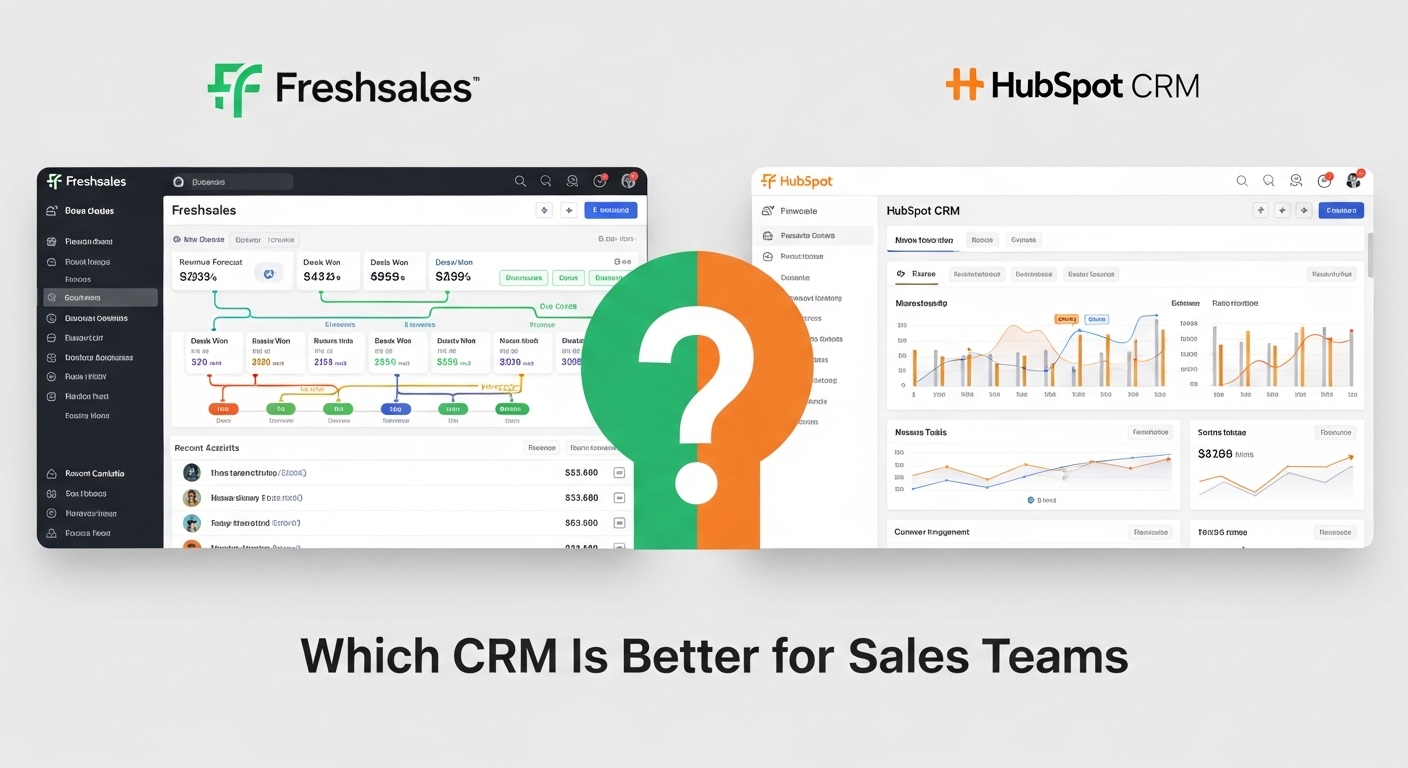
Choosing between Freshsales and HubSpot CRM is a foundational revenue operations decision. It is not merely about comparing buttons or dashboard colors; it is about deciding how your business will capture, nurture, and close revenue. A sales-first CRM like Freshsales is built to optimize the daily grind of deal execution. It prioritizes the “high-velocity” sales rep who needs integrated communication tools, AI-powered lead scoring, and automated sequences to move prospects through the pipeline as fast as possible.
In contrast, a marketing-first CRM like HubSpot is designed as a unified revenue ecosystem. It focuses on the entire customer lifecycle, starting with inbound lead generation and content-driven attraction. While HubSpot offers powerful sales tools, its true strength lies in how it connects marketing automation, content management, and service desk functionality into a single source of truth. Selecting the right platform requires you to look at your lead source model. If your growth depends on aggressive outbound sales and pipeline efficiency, you need a sales-focused framework. If your strategy relies on complex inbound marketing and long-term customer lifecycle management, a marketing-led platform is the standard.
Freshsales vs HubSpot CRM: Quick Decision Summary
The choice between freshsales vs hubspot crm depends on whether your priority is sales execution speed or a complete marketing-and-sales ecosystem. Freshsales is the superior option for high-velocity sales teams that need built-in telephony and affordable AI automation. HubSpot CRM is the better choice for businesses that want to integrate advanced inbound marketing, content hosting, and multi-departmental data in one unified platform.
| Feature | Freshsales | HubSpot CRM |
| Platform Focus | Sales Pipeline Execution | Unified Marketing & Sales |
| Setup Complexity | Low (Ready in hours) | Moderate (Requires configuration) |
| Built-in Telephony | Native (Call from CRM) | Available (Standard integrations) |
| Marketing Tools | Basic (Email & Sequences) | Advanced (Ads, SEO, CMS) |
| AI Capabilities | Sales-focused (Freddy AI) | Marketing & Workflow focused |
| Free Version | Up to 3 users | Unlimited users (Limited features) |
| Scalability | High (Cost-effective per seat) | Very High (Expensive as you grow) |
What Is Freshsales?
Freshsales is a sales focused CRM designed to eliminate the need for a fragmented sales stack. Built by Freshworks, it serves as a pipeline execution CRM that combines contact management, built-in telephony, and email sequencing into a single interface. This eliminates the “toggle tax” that sales reps often pay when switching between their CRM, their phone system, and their email automation tools. Freshsales is designed for teams that value “high-velocity” selling, where lead scoring and automated follow-ups are essential for hitting quotas.
As an SMB sales CRM software, Freshsales stands out for its simplicity and built-in AI assistant, Freddy AI. This engine provides deal insights, predicts which prospects are most likely to close, and helps reps focus their energy on the “hottest” opportunities. It offers a structured approach to lead management, allowing teams to build multiple visual pipelines that mirror their specific sales process. For businesses that want to get up and running without a six-month implementation project, Freshsales provides a robust, out-of-the-box solution that prioritizes the rep’s productivity above all else.
What Is HubSpot CRM?
HubSpot CRM is a marketing automation CRM platform that acts as the central hub for a company’s entire revenue operation. It is not just a place to store contacts; it is an inbound marketing CRM platform that manages the entire customer journey from the first website visit to the final support ticket. HubSpot’s “Flywheel” philosophy ensures that marketing, sales, and service data are perfectly aligned. This makes it a preferred choice for companies that rely on content marketing, SEO, and lead nurturing to fuel their growth.
Within this customer lifecycle CRM ecosystem, HubSpot provides tools for landing page creation, social media management, and advanced email marketing alongside its core CRM features. While it is highly intuitive, its real power is unlocked through the “Hub” system, where you can add specialized modules for Sales, Marketing, Service, Operations, and Content. This marketing and sales platform is built for extreme scalability, allowing a startup to begin on a free plan and grow into a multi-billion dollar enterprise without ever changing their underlying database infrastructure.
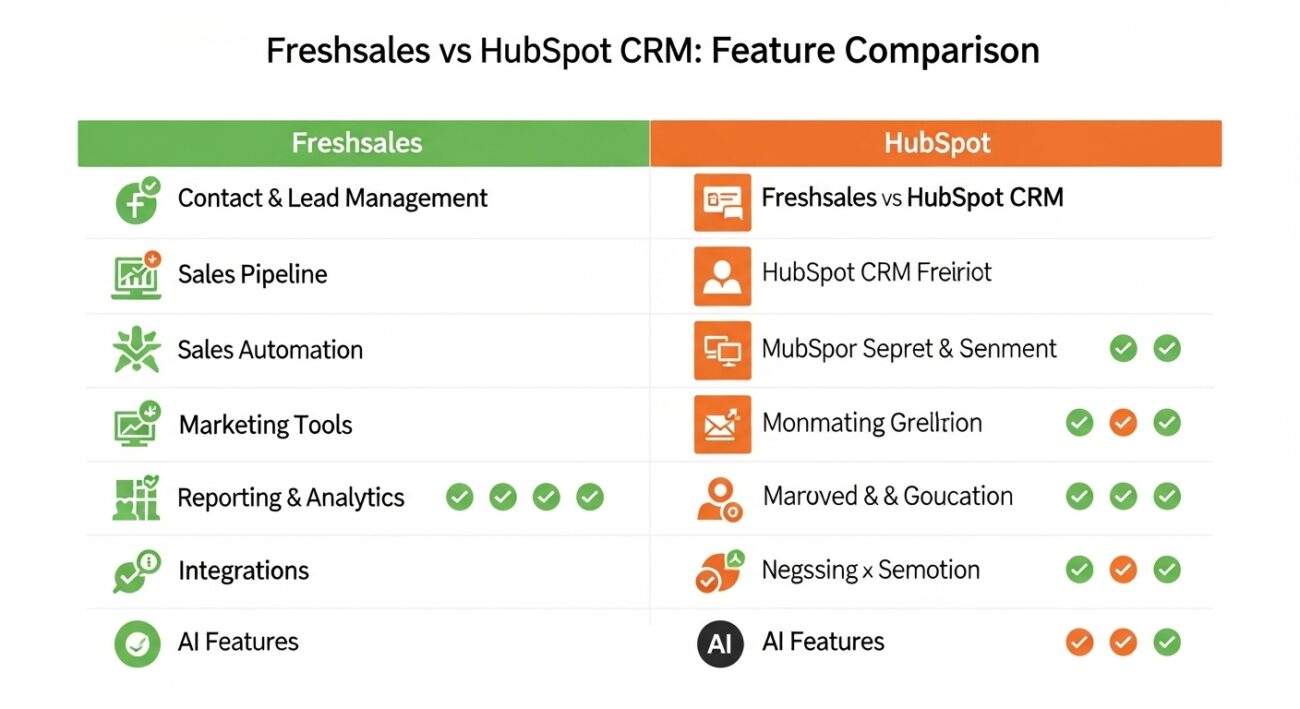
Freshsales vs HubSpot CRM: Feature Comparison
When you perform a freshsales vs hubspot features comparison, you can see how each tool handles the daily workflow of a revenue team.
Contact & Lead Management
Freshsales treats contacts as active participants in a sales cycle. It uses AI to score leads based on their engagement and demographic data. HubSpot focuses more on the “lead lifecycle,” tracking every touchpoint from the first time they clicked an ad or downloaded a whitepaper. HubSpot’s data structure is more comprehensive for long-term tracking, while Freshsales is more focused on the immediate “next action.”
Sales Pipeline Management
Hubspot crm vs freshsales is a battle of visualization. Freshsales offers a very clean, Kanban-style pipeline that is easy to customize. It includes “Rotten Deal” alerts to flag stagnant opportunities. HubSpot’s pipeline management is equally visual but offers more advanced reporting on “deal stage velocity,” helping managers see exactly where deals get stuck in the funnel.
Sales Automation
Freshsales excels at built-in sales sequences. You can set up automated emails, SMS, and tasks without needing third-party integrations. HubSpot’s automation is managed through its “Workflows” engine. While HubSpot’s workflows are significantly more powerful and can handle complex “if/then” logic across different departments, they are typically locked behind their more expensive “Professional” tiers.
Marketing Tools
This is the primary advantage for HubSpot. It includes built-in tools for SEO, ad management, and website hosting. Freshsales or hubspot decision-makers often choose HubSpot because they want their CRM to double as their marketing engine. Freshsales has basic marketing capabilities, but for advanced automation, you usually have to bundle it with other Freshworks products.
Reporting & Analytics
Freshsales provides excellent “out-of-the-box” sales reports focusing on rep performance and quota attainment. HubSpot offers a more holistic “Revenue Attribution” report. It can tell you exactly which blog post or marketing email led to a closed deal, which is vital for calculating the ROI of your marketing spend.
Integrations
HubSpot has one of the largest app marketplaces in the SaaS world, with thousands of native integrations. If you use a niche tool, HubSpot likely connects to it. Freshsales has a smaller, more curated marketplace. However, because Freshsales builds more features into the core tool (like the phone and email), you may find you need fewer integrations to get the job done.
AI Features
Freshsales uses Freddy AI to help with sales productivity—generating email copy and forecasting revenue. HubSpot’s AI focus is broader, offering “Content Remix” tools and marketing-focused AI agents that help automate the creation of campaigns and customer service responses.
Pricing Comparison
The hubspot vs freshsales pricing debate is often where the decision is made for SMBs. You must look at the lifecycle cost, not just the initial quote.
Freshsales is significantly more affordable for growing teams. Its “Growth” plan starts at approximately $9 per user per month, and even its “Enterprise” tier is capped at around $59 per user per month. There are no mandatory onboarding fees, and most features—including the built-in phone—are included at no extra cost. This makes the CRM total cost of ownership very predictable as you add more sales reps.
HubSpot’s pricing scales differently. While they have an excellent “Free” tier and “Starter” plans beginning at $15–$20 per user, the jump to the “Professional” tier is massive, often starting at $450–$800 per month for a set number of seats. Additionally, HubSpot requires mandatory “Professional Onboarding” fees for its higher tiers, which can range from $1,500 to $6,000.
As your marketing database grows, HubSpot also charges based on the number of “marketing contacts” you have. If you have 50,000 leads, your HubSpot bill will reflect that, even if you aren’t actively selling to all of them. Freshsales is the better value for pure sales execution at scale, while HubSpot is a major investment that pays off if you utilize the full power of its marketing and service hubs.
Sales-First CRM vs Marketing-First CRM
Understanding the difference between a sales execution CRM and a marketing lifecycle CRM is critical for your long-term strategy.
A sales-first platform like Freshsales is built for outbound efficiency. The software assumes your reps are proactively reaching out, making calls, and driving deals forward. The architecture is optimized for high-volume activity and immediate pipeline movement. This is a “linear” growth strategy—more reps equals more deals.
A marketing-first platform like HubSpot is built for inbound momentum. It assumes your growth comes from creating value, attracting leads through content, and nurturing them over time. The architecture is designed to manage complex data relationships and customer journeys. This is a “flywheel” strategy—better content and automation lead to a self-sustaining engine of leads and referrals. Your revenue operations CRM strategy should match whichever model drives your business.
Which CRM Should You Choose?
Use this framework to find your CRM buyer decision framework match based on your current business stage:
Choose Freshsales if:
- You are a sales-heavy organization (outbound, cold calling, high-volume deals).
- You want a CRM with a built-in phone system to reduce costs and complexity.
- You need an affordable, AI-powered tool that is easy for reps to adopt.
- You are an SMB that wants “Pro” features without paying “Enterprise” prices.
- You don’t have a dedicated CRM administrator and need something that “just works.”
Choose HubSpot CRM if:
- You rely heavily on inbound marketing, SEO, and content to find customers.
- You want a unified platform for sales, marketing, and customer service.
- You have the budget for a long-term investment and professional onboarding.
- You need advanced reporting that connects marketing spend to closed revenue.
- You are looking for a hubspot alternatives freshsales comparison but realize you need a full CMS and marketing suite.
If you are comparing this to other enterprise solutions, you might also look at our HubSpot vs Salesforce guide or see how small teams manage workflows in our Zoho CRM vs Pipedrive comparison.
When NOT to Choose Freshsales
Do not choose Freshsales if your marketing team needs a world-class automation platform. Freshsales is a sales tool first. If you need to manage complex ad campaigns, host a blog, or run sophisticated A/B tests on landing pages, you will find Freshsales’ marketing capabilities too limiting. It is also not the best choice if you require an extremely deep marketplace of thousands of third-party integrations, as its ecosystem is more focused than HubSpot’s.
When NOT to Choose HubSpot CRM
Do not choose HubSpot CRM if you are on a tight budget and only need basic sales tracking. The “Professional” price jump is a common point of frustration for SMBs. If you don’t plan on using the marketing tools or the CMS, you are paying for an ecosystem you don’t need. Avoid HubSpot if you want a simple, “lean” tool for a 3-person sales team that just needs to make calls and track emails; the complexity and cost of HubSpot will be overkill.
Switching Between Freshsales and HubSpot CRM
Moving from one CRM to another is a major CRM migration planning task. It is not just about moving CSV files; it is about a CRM workflow redesign.
When moving from HubSpot to Freshsales, you are often simplifying your stack. You may need to cancel separate phone and email sequence subscriptions. When moving from Freshsales to HubSpot, you are “expanding” your stack, which requires significant training to help your team understand the broader marketing and service modules. The CRM switching cost is usually measured in lost productivity and the time it takes to rebuild your automation logic in a new environment.
Final Verdict
The CRM final decision summary is clear:
- Freshsales is the champion of sales productivity and SMB value. It is the best choice for high-energy sales teams that want to close more deals with less software bloat.
- HubSpot CRM is the champion of unified revenue operations. It is the best choice for businesses that want a powerful, all-in-one engine to drive their entire customer lifecycle.
For more insights into the best business tools, visit our Software Comparisons Hub or check out our comparison of Google Workspace vs Microsoft 365.