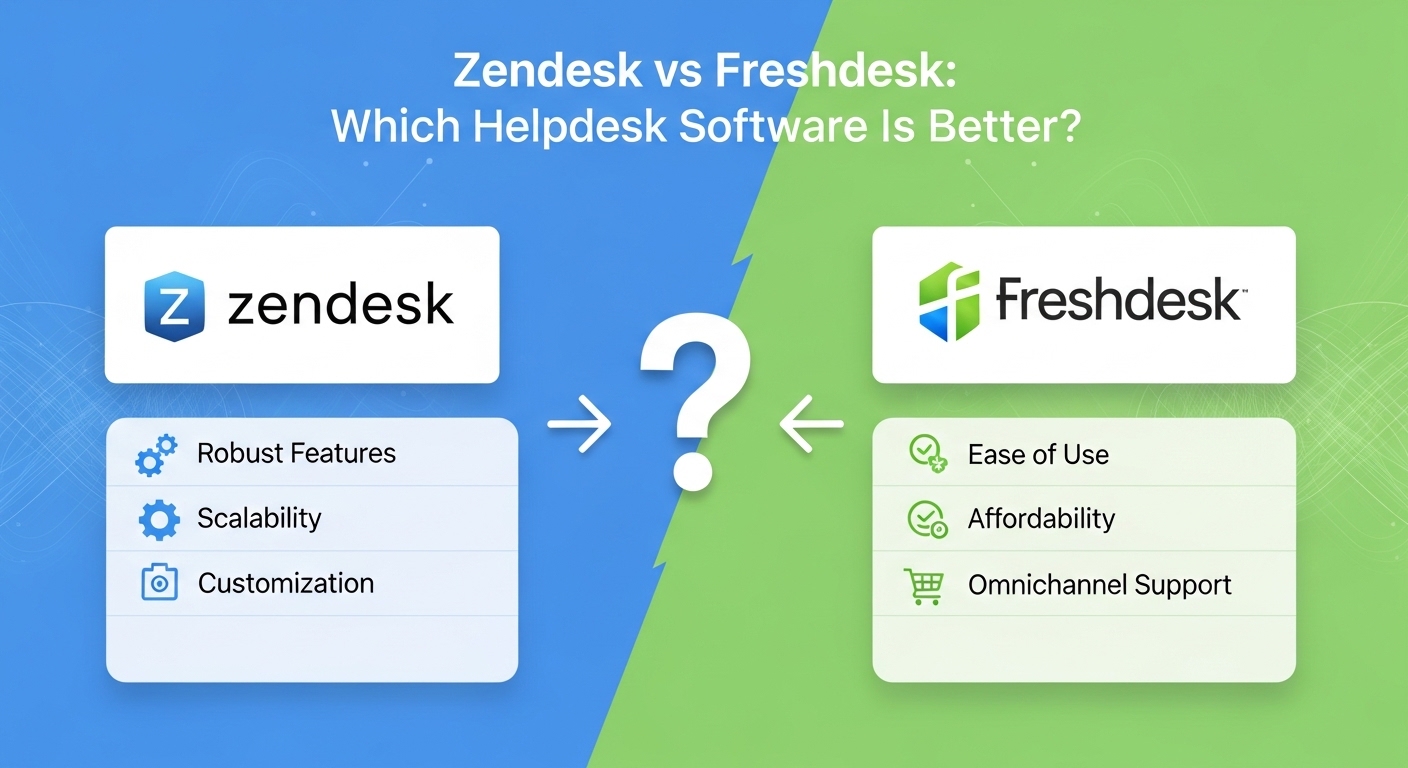
Choosing between zendesk vs freshdesk is a decision about your support organization’s maturity and its future scaling trajectory. In the current landscape, this choice defines whether you are investing in a highly customizable enterprise engine or a streamlined, agile helpdesk built for rapid deployment. This is not just a ticketing system comparison; it is a choice of how your team will manage customer happiness at scale.
An enterprise support platform like Zendesk offers unparalleled depth in automation, granular permissions, and complex multi-brand workflows. It is designed for large-scale operations where even a 1% increase in efficiency across 500 agents translates into significant cost savings. Conversely, an SMB helpdesk platform like Freshdesk prioritizes the “time-to-value” metric. It provides a highly intuitive interface and built-in automation that allows a growing team to handle increasing ticket volumes without the need for a dedicated system administrator or a three-month implementation cycle.
Ultimately, your support operations software selection should match your internal technical bandwidth. If you require deep integration with legacy ERPs and surgical control over every trigger and macro, you are choosing a framework for long-term customization. If your goal is to empower a high-growth team with modern, cloud-native tools that “just work” out of the box, you are choosing a platform that favors usability and speed.
Quick Decision Summary: Zendesk vs Freshdesk
The decision in the freshdesk vs zendesk comparison rests on your need for enterprise-level customization versus mid-market agility. Zendesk is the better choice for large-scale organizations that require deep omnichannel integration and complex workflow logic. Freshdesk is the superior choice for small-to-midsize businesses that need a user-friendly interface, fast setup, and a more predictable cost structure.
| Feature | Zendesk | Freshdesk |
| Primary Target | Mid-market to Enterprise | Small to Mid-market |
| Setup Time | Weeks to Months | Days to Weeks |
| Omnichannel | Deeply integrated (Social, Web, Voice) | Broad, easy-to-use channels |
| Automation | Highly granular (Triggers/Automations) | Simple, rule-based logic |
| Reporting | Advanced (Zendesk Explore) | Standard (Freshdesk Analytics) |
| AI Focus | Agent Productivity & Intent Detection | AI Assistant & Chatbot Simplicity |
| Ease of Use | Moderate (Learning curve) | High (Intuitive) |
What Is Zendesk?
Zendesk is a comprehensive enterprise helpdesk platform that has defined the customer experience space for over a decade. It is an omnichannel support software suite that centralizes interactions from email, phone, social media, and messaging apps into a single, unified agent workspace. The platform is designed to handle the complexity of massive support teams, offering features like skill-based routing, which ensures that a high-priority billing ticket always goes to the most qualified agent rather than the next available one.
As an enterprise customer support system, Zendesk’s core strength lies in its “Sunshine” platform—an open, flexible architecture that allows developers to build custom apps and integrations. This makes it a powerful support workflow automation platform for companies that have unique service requirements that “out-of-the-box” solutions cannot meet. While the initial configuration can be complex, the result is a tailor-made support environment that can handle millions of tickets without breaking.
What Is Freshdesk?
Freshdesk is a cloud helpdesk platform part of the Freshworks ecosystem, designed to make customer support simple and efficient. It is an SMB helpdesk software solution that prides itself on being remarkably easy to set up and manage. Freshdesk uses a “gamified” approach to helpdesk management, turning ticket resolution into a more engaging experience for agents while maintaining a clean, modern interface that requires minimal training.
This ticket management software is built for the “modern” support team that needs to be live within hours. It offers powerful support automation for SMB users, such as “Scenario Automations,” which allow agents to perform multiple actions—like changing a ticket status, adding a tag, and sending a follow-up email—with a single click. Freshdesk provides all the essential tools for a growing business, including a robust knowledge base, multi-channel support, and AI-powered help, without the administrative burden typically associated with enterprise-grade software.
Zendesk vs Freshdesk: Feature Comparison
When you compare zendesk and freshdesk, you are looking at two different philosophies of service delivery.
Ticket Management
Zendesk offers surgical precision in its ticket workflows. You can create complex “triggers” based on any ticket property imaginable. Freshdesk or zendesk users often find that while Freshdesk’s ticket management is simpler, it is often more intuitive for the average agent to learn quickly. Freshdesk uses a “Card” view that feels very familiar to social media users.
Omnichannel Support
Zendesk has the edge in omnichannel support depth, especially with its “Agent Workspace” which handles live chats, WhatsApp messages, and emails in a single stream. Freshdesk is very capable here but tends to feel more like a collection of separate channels that are well-integrated, rather than a single unified stream from the ground up.
Automation & Workflows
Zendesk’s automation engine is like a programming language; if you can think of a rule, you can build it. Freshdesk’s automation is designed for speed. It uses a “Dispatch’r” to sort new tickets and an “Observer” to watch for changes. It’s easier to set up, but has fewer “if/then” combinations than Zendesk.
Reporting & Analytics
Zendesk Explore is a powerhouse enterprise reporting tool that allows you to build custom dashboards from scratch. Freshdesk Analytics is excellent for standard metrics (First Response Time, CSAT), but it lacks the deep data-manipulation capabilities that a data analyst would want in a large-scale organization.
Knowledge Base Tools
Both offer great self-service tools. Zendesk’s “Guide” allows for highly customized themes and multi-language support that scales across dozens of brands. Freshdesk’s knowledge base is straightforward and allows you to turn ticket replies into draft articles instantly, which is a massive time-saver for smaller teams.
AI Support Tools
Zendesk uses AI to detect “customer intent” and “sentiment,” helping agents prioritize angry customers automatically. Freshdesk’s “Freddy AI” focuses more on assisting the agent with draft replies and summarizing long ticket threads, making it a more practical assistant for day-to-day productivity.
Integrations
Zendesk has a massive marketplace with over 1,000 apps. If you use a niche enterprise CRM or ERP, there is likely a pre-built connector. Freshdesk has a smaller but high-quality marketplace that covers all the major tools like Slack, Shopify, and Salesforce.
Pricing Comparison
The zendesk vs freshdesk pricing discussion is about more than just the monthly per-agent fee; it’s about the support software total cost.
Zendesk pricing usually starts around $55 per agent/month for their “Suite Team” plan. However, to get the advanced reporting and routing that makes Zendesk valuable, most companies end up on the “Suite Professional” ($115/agent/month) or “Suite Enterprise” plans. You also have to factor in the cost of a consultant or a dedicated admin to manage the platform as you grow.
Freshdesk offers a much more accessible entry point. They have a “Free” plan for basic needs and their paid plans start around $15 per agent/month. Their “Pro” plan, which is their most popular, is roughly $49 per agent/month. The support platform cost scaling is much more predictable here because the platform is designed to be self-managed. You won’t need to hire a “Zendesk Administrator” to change a workflow in Freshdesk, which can save a business $80,000+ a year in salary alone.
Which Helpdesk Is Better for Different Team Sizes?
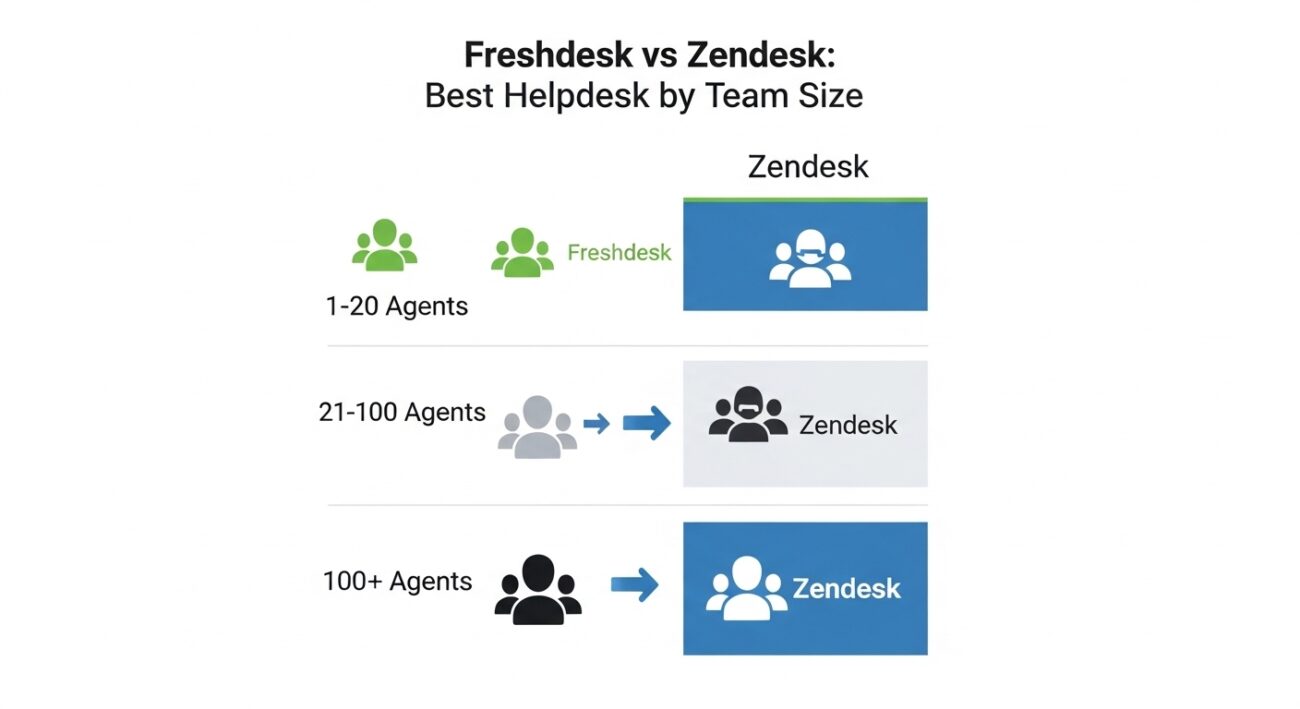
Your support team software selection should reflect your current agent count and your 2-year growth projection.
- Teams of 1-20 Agents: Choose Freshdesk. You need to focus on resolving tickets, not managing software. Freshdesk’s ease of use ensures your team is productive from day one.
- Teams of 21-100 Agents: This is the “grey area.” If your workflows are standard, Freshdesk saves you money and complexity. If you have highly specialized roles and multi-departmental handoffs, Zendesk might be worth the investment.
- Teams of 100+ Agents: Choose Zendesk. At this scale, the granular control over agent permissions, skill-based routing, and custom reporting becomes essential for maintaining quality and efficiency.
Which Is Easier to Use?
In any helpdesk usability comparison, Freshdesk wins. The interface is light, fast, and requires almost no “training manual.” A new agent can be answering tickets within 15 minutes of logging in.
Zendesk has a much steeper ticketing system learning curve. Because it is so powerful, there are many screens and settings that can be confusing to a new user. Implementation typically requires a “project manager” to ensure the triggers and automations don’t conflict with each other. If you want speed, choose Freshdesk. If you want a platform your team can “grow into” over five years, choose Zendesk.
When NOT to Choose Zendesk
Do not choose Zendesk if you are a small startup with a limited budget and no IT support. The enterprise support software cost risk is real; you can easily overpay for features you won’t use for years. Avoid Zendesk if you want to be “live by Monday”—the configuration time alone will likely take longer than that.
When NOT to Choose Freshdesk
Do not choose Freshdesk if you have highly complex, non-linear support workflows. If a single ticket needs to trigger actions in three other departments and follow a very specific logic path that changes daily, you will hit support software scaling limitations. Also, if you need deep, custom data analysis beyond standard support metrics, Freshdesk’s reporting will eventually feel too restrictive.
Switching Between Zendesk and Freshdesk
A helpdesk migration planning project is a significant undertaking. While tools like “Help Desk Migration” can move your tickets and contacts, they cannot move your “business logic.”
The support software switching cost is high because you have to recreate every automation, trigger, and macro in the new system. When moving from Freshdesk to Zendesk, you are essentially moving from a “pre-built house” to a “custom-build.” When moving from Zendesk to Freshdesk, you are simplifying your life but may find that some highly specific automations you relied on have to be simplified or handled manually.
Final Verdict
The helpdesk platform final decision comes down to your operational philosophy.
- Choose Freshdesk if you value simplicity, fast deployment, and a lower total cost of ownership. It is the best choice for SMBs and mid-market companies that want to focus on their customers rather than their tools.
- Choose Zendesk if you are an enterprise organization that needs total control, deep customization, and the ability to scale complex workflows across global teams.
If you’re still looking at how to integrate your helpdesk with other tools, see our guide on Freshsales vs HubSpot CRM or compare broader platforms in our Software Comparisons Hub.